Wednesday, 27 May 2009

When it comes to scandals, size really doesn't matter


Life may not imitate art but my conversations seem to follow on from my blog posts in a rather peculiar way. Barely a week since my 'dangers of not caring post' and I am sitting in the most unlikely of settings – a wedding reception – talking to a complete stranger about this and that. The stranger, it turns out, lives and works in Zimbabwe and on those grounds dismisses the British MPs expenses scandal.
When put that way it makes no sense does it? But you've seen it happen again and again.
'You call this a scandal? Wait till you've seen one of ours'. The principle here, evidently, being that when it comes to scandals size does matter.
Well, friends, I am not sure it does.

In case you've missed it (because as luck has it you may live in a country that has impressive, block-buster style scandals and this one did not register as being worthy of column inches in your location) the UK is in the midst of a scandal of its own around the expense claims members of Parliament have been submitting and getting away with. Such claims range from the illegal (mortgage payments for a house that is already mortgage-free) to the absurd (cleaning a moat, yes a moat) to the downright hilarious (porn for the MP's husband). Claims cover huge value items such as houses and tiny items such as a chocolate bar. And if I am allowed to digress briefly, I am not entirely sure which one of the two extremes bugs me more – the insanely huge bills on something like new hardwood floors and chandeliers or the tiny tiny bills for tampons and fizzy drinks. Obviously, as a tax payer I resent the massive items more yet, as a citizen, I find the small ticket items more offensive because they seem to be telling me that the MPs have no intention of using their salary to pay for anything. At all. Ever.
But I digress.
The point is, some of these claims are illegal but mostly they are within the rules and that is the problem: that the rules allow for way too much of this to go on so the rules need to be reformed while the rest of us have a conversation about morality and whether the MPs were actually breaching our trust and their sacred duty even if they were not breaking the law.

And all this is very important. In a democracy.
Because it entails discussions of trust in your elected representatives and systemic transparency. Because it concerns the use and potential misuse of public funds and the public, whose funds these actually are, merits an explanation and an apology.
And because this is supposed to be a democracy the fact that regulations exist does not end the matter. We need to ask if the regulations are appropriate to the situation, whether they do what we want them to do, whether our system is serving us as it ought to.

Which is where the person living in Zimbabwe guffawed saying it was sweet that those of us living in England could get flustered over things like the expenses scandal when corruption and inefficiency in their political life is so high and so common that millions of dollars' worth of public funds appear in politicians' bank accounts and nobody even thinks about prosecuting.
In short this translates to 'you guys have nothing, ours is bigger than yours'.

And my first reaction was a need to win, to trump her, to show her I had scandals as big as hers up my sleeve.
It was an interesting inversion as my interlocutor is English albeit living in Zimbabwe and I am, as you all know, Greek living in England. So what England fails to provide by way of scandals, the motherland obligingly offers. 'You call that corruption? We closed down Parliament for 5 months, we have massive scandals implicating the government, opposition, private sector and some priests to boot. We have corrupt policemen, corrupt judges, corrupt civil servants. Millions of euros go missing from public coffers as a matter of course, rights are trampled, nothing moves without bribery and nobody even blinks. Try that one on for size'. My scandal is bigger than yours. I win. Well done me.
Only not so well done as scandals are not good things and big bad things are a whole load of bad more than small bad things. So what's with the pride in being totally shambolic? And exactly why are you so chuffed your scandal is bigger than anybody else's? This is one of those things where size really really doesn't matter.

And that's the problem with comparisons.
You put something next to something else and all of a sudden both are reduced to the sum of their differences. Inevitably one will be bigger. And then what?
The fact that Zimbabwe is more corrupt than the UK and Greece is somewhere in between does not absolve Greece and the UK, it does not render their inadequacies irrelevant, it does not make taking the citizens for a ride ok if others do it too.

We all live in imperfect systems, that much we know.
Power corrupts and no political system has ever escaped sleaze, corruption, misuse. The question is what do you do to prevent it and, when it occurs, what do you do about it?
In Zimbabwe, you do nothing because doing something may put you in real physical danger.
In Greece, you do nothing because, well we've been through this before: you do nothing because corruption is what you expect, scandal is what public life is made of.
And in Britain? In Britain you do nothing until you can no longer get away with doing nothing. And then you do the absolute minimum but at least you do it and therein lies the difference.

British public life is full of blunders, attempts at cover ups, corruption and dishonesty. But there is also this basic instinct somewhere in the gut of the body politic that something needs to be done about the things that are going seriously wrong.
So when the expenses scandal appeared, the newspapers screamed bloody murder until an investigation started and some heads rolled. The rules will be revised. And at the end of it all the system will still be imperfect, corruption will still be a possibility, but it will not be the norm.
So rather than laughing at them, because their scandal is smaller than ours, how about we take a leaf out of their book and stop taking scandals for granted?

This is not an art to be perfected, size does not denote expertise and 'when you do it, do it right' should not be the attitude we take to corruption.
Scandals are bad, boys and girls, and on this one size really doesn't matter: a scandal is a scandal is a scandal – big or small, the only constant fact about them is that they shouldn't be there.
And if ours is bigger than anyone else's then one thing we shouldn't be doing is a victory dance.

Wednesday, 20 May 2009

The dangers of not caring


Politics.
I love it. I hate it.
It moves me. It inspires me. It pains me. It angers me.

And, as you know only too well, I don't shut up about it.

Of course I know few care about politics as much as I do. But I avoid people who don't care at all. I don't want their friendship, I don't want their time. And that's not because I am an intellectual snob (ok, maybe a little) but because of two fundamental and interconnected beliefs I hold: 1. politics is everything and 2. only fools fail to care about what doesn't immediately concern them. Because only a fool feels sheltered from bad things happening elsewhere or to other people.

Let me explain.
There are people who think that politics equal elections and tax reform, parties and prime minister's question time. Of course all this is politics but everything else is politics too. Nobody is outside it. School curricula, bus routes, pub opening times are all political and not just because they are regulated by law, policy and institutional practice. Whether you can buy fags in the supermarket, enjoy a late-night pint, adopt a child, sign your child out of school, buy a house with a partner, have a duvet day and take your boss to HR for being a bully boils down to politics. Politicians may not be involved but policy, principle, communal action and public negotiation are involved and that makes all of this political. You call it what you like. It is politics to me. If it entails the ordering of public life, the negotiation of social interactions and the matching of realities to ideas then it is political. So everything is political and politics is everything.

On the second issue. Well. I've already said that I believe that the ability for reflection, abstraction and compassion is what singles humans out from the rest of the animal kingdom. We can see the significance of things that don't directly affect us. We are capable of caring for and about things taking place outside our own backyard. Some times we choose not to care. But we still have the ability.

Well, when it comes to choosing my friends, an ability and propensity to care is something of a clincher.

So it has come as a huge shock to me, how many of my own friends in Greece don't care.
They do.
But they don't.
They care about the civil war in Sri Lanka being over and civilian deaths in Pakistan proliferating. They care about Darfur and the fact that Palestine is still not at peace. They care about Guantanamo Bay. They care about the British MPs' expenses scandals. They care both about the what and about the why. And they care about the implications of all that they care about.
But try talking to them about Greek politics and they talk to you about Sakis and the Eurovision.

Yes they know things on the political front are bad. They know. A boy standing trial only yesterday for wearing green shoes, a man being attacked by a flower pot (the police find ever more creative ways of dismissing injuries suffered during interrogation or arrest) and parliament being shut for 5 months so it doesn't get in the way, yes they know all these things and they know how bad they are. And they know why they are bad. But they don't want to talk about it. Or do anything about it.
And why not?
Because they are tired. And bored. And feel they've seen it all before. Which I guess they have to a certain extent. But that makes it worse, not better.

But because people are jaded and care less; because they don't expect anything good from their politicians; because corruption and ineffectiveness surprise no-one, these have become the baseline that politicians work from.
When expectations are below zero it's almost impossible to truly disappoint. So politics is no longer about ideas, policy or persuasion, it's not even about compromise and image management. The voters expect nothing between elections so the politicians deliver nothing between elections. Instead they focus on the game at hand – securing power, getting pay-offs, getting re-elected.

Politics has become a binary game of election/non-election for those playing it: did I get in? Doesn't' matter how many votes I got or how I got them, I'm in. Is my party in power? Forget about protest voting, the narrowness or margins and political intimidation. Forget about mandates and policy promises. Forget about pressing problems. Did we get in?
Yes/no, black/white – binary.
Only politics is not binary. It is convoluted and multi-faceted, complicated and multi-layered, nuanced and always capable of as many possible endings as there are people on this earth. So politics, the activity of negotiating public life, only works if we care enough to acknowledge its complexity and seek compromise.
Our politicians don't – they've gone binary.
And more and more people don't – they are as tired as their prime minister it seems.

So what are we left with?
An ever-plummeting benchmark of acceptability: it takes more and more to shock us so there's forever more the politicians can get away with before we will go 'hold on a minute buster'.

First I thought all the scandals would do it.
Then I thought the runaway police and colluding judicial system would do it.
Finally I thought closing down parliament would get people on their feet.
But no.
People are blasé, tired, bored.
They expect little so when they get little they are not surprised.
A pretty sweet deal if you are a politician I guess.
But for the rest of us it's a pretty dangerous place to be, a dangerous thing to have given away, a slippery slope without crash barriers.

Because if you were a politician and you did get away with all this, wouldn't you find yourself wondering what else you can get away with?

Monday, 11 May 2009

If it looks like a dictatorship and acts like a dictatorship


He adjurned Parliament.
The Greek Prime Minister shut up shop.
It doesn’t compute, does it?
Dictators dismiss Parliament, elected Prime Ministers call elections. You’d think.
But no, he decided Parliament can go home for a few weeks, shocking even his own team.

Why?
Because Parliament was investigating his government for a number of scandals (code names: Vatopedio, SIEMENS, Germanos – among others) and there was a real and present danger that unpleasant things would be discovered, ugly truths would be told.
But why wait around for bad things to happen when you can go all dictatorial and just send the MPs home?
Of course this is not the stated reason – the European election is – and all this is conjecture on my part. Nevertheless four things are true:
Parliament was investigating a number of scandals; members of the governing party appear heavily implicated (read: in it up to their eyeballs); the opposition party was leading at the pre-European election polls; parliament was sent home. You do the math.

So now the Prime Minister doesn’t need to worry his pretty head over managing the scandal debates in Parliament and he can focus all his energies on mounting a vicious and vitriolic election campaign. The opposition party is ahead in the polls, you see, and governing the way the constitution prescribes would get in our PM’s way of winning the election – which is what he’s there for. Right?
Only, hold on, the election in question is for MEPs, not for a new national government. The Prime Minister is not actually running in it. But his party is and he needs the message at the polls to be loud and clear ‘Costa: your people love you’. And what’s a month’s worth of parliamentary deliberations compared to happy news for the party?

So here we go, the longest recess for Parliament before a European election – otherwise known as ‘a way of stopping the deliberations and scandals’ discussions’. Nice work Costa. Nice work.

If you are wondering on the ‘how’ – as in ‘how the hell did he pull that one off’ – it seems that our Premier spoke with the ‘boys’ (high ranking ministers within the party tho not necessarily male – hint hint) and then ambushed the president of the republic after the day’s news cycle had closed on Friday. Apparently most of the governing party were surprised by the announcement and scrambled to see to unfinished business when they heard. On Friday night, high-ranking governing politicians were informed after the ball had been set rolling whereas lower-ranking government MPs were stunned and confused after hearing it on the news.
Shall I say it again: that’s how dictatorships come about. A small group strike under cover of darkness and the inner circle are presented with a fait accompli once the process is set in motion.
The people usually sleep on until it’s too late.

Of course the government claim that they have nothing to hide and parliament is shut because they don’t want to politicise the elections. Oh I like this one. This one actually made me laugh out loud. The PM actually stressed his continued commitment to the ‘big issues’ that plague our land. And he practically expressed this commitment by sending parliament home. This buys him not one but five months of peace and quiet as summer recess kicks in by the time they are all back from this unexpected holiday. And with this little interlude comes blissful over-right for a series of cases that concern the ‘first period’ of the governing party’s period in office.

So yes, a number of uncomfortable issues will now be silenced. Legally. Don’t you just love procedure and regulations?
Meanwhile the political leaders are still accusing each other of ‘political cowardice’ and a tendency to ‘politicise the agenda’. And to be honest with you all, I’ll be damned if I know what any of that means any more.

But the leader of the opposition, always on the ball, challenged the prime minister to call early national elections, castigating the early closure of parliament as an ‘institutional digression’. You tell him boy. Bet he’s shaking in his boots now.
Don't you just love made-up innocent-sounding names for things? It’s not unconstitutional it’s an ‘institutional digression’. Linguistic acrobatics obscuring the issue. Otherwise known as grade-A bullshit.
How about we say it like it really is: Dismissing parliament threatens democracy, constitutionality and the rule of law.
Is anyone listening over there?

And here we are being asked to vote for MEPs. In fact we are being encouraged to turn up en masse for the European election, to ‘send a message’. That’s what both the party leaders want us to do. Send a message to the other guy.
They count on us to carry on acting like elections are simply about sending messages. Not about electing decision-makers. Who will then govern.

And while adjourning parliament for a whole month in order to focus on a different, separate and unrelated election, makes a mockery of democracy and politics as a whole, what I want to know is why does no-one feel like the system is sliding into dictatorship?
Dictators don’t always wear uniforms. Dictators don’t always launch campaigns of death and destruction. Dictators can wear suits and be the butt of jokes. The measure of the regime is not how afraid of them you actually are but how afraid you should be. What makes a dictator is not how many people he kills but whether he ignores democratic structures and legal frameworks in going about the business of government.
And Costa’s greatest success to-date is that he keeps breaking our already derelict system bit by bit and we are still not afraid. Tired, fed up, amused, disgusted – but not afraid.

Wake up and smell the bacon brothers – if it acts like a dictatorship, reacts like a dictatorship and looks like a dictatorship then maybe we should treat it like one and start fighting it again.

Tuesday, 5 May 2009

The criminalisation of the Converse All-Star


Welcome to a lesson in logic, courtesy of the Greek police.

On the 19th of May 2009, Panagiotis Ketikis will stand trial. For wearing converse.
So you won’t think I am putting it too strongly when I say, this could have been me, this could have been you. This trial concerns us all. Especially those of us wearing converse. Or care about the rule of law. Or care about politics and hope for change.

On May 5th 2007 there was rioting and some vandalism in the centre of Thessaloniki. What’s new, you say.
Some hours after the events and a few roads along, where Egnatias and 3rd September roads meet, Panagiotis was stopped and taken into custody, initially to confirm his identity (yes Greek police can do that. Yes Greek police do do that every chance they get).

Upon arrival to the police station and, presumably, after checking Panagiotis’ file, the policemen must have thought Christmas came early. Panagiotis had a previous arrest on his record, you see.
A few months previously Panagiotis had been arrested alongside another 48 people, accused of vandalism during a demonstration in favour of universal free education.
All 49 were acquitted.
But why should the police let facts stand in the way of a good story?
Panagiotis was there and the police needed a suspect.

So yet again Panagiotis is accused of something he has not done.
Only this time resolution has not been quick.
Only this time, not only did he not do what they say he did – he wasn’t even there.

On Saturday the 5th of May Panagiotis was at his university campus at a party.
So he has an alibi and more witnesses than you can shake a stick at that he was not where the police say he was. But that doesn’t stop the prosecution from proceeding. You see there is irrefutable evidence that Panagiotis was one of the vandals at work in the centre of town on that 5th of May 2007: one of the vandals had been wearing a pair of converse and Panagiotis was wearing a pair of green converse when stopped by police. QED, thought the Greek policemen and arrested the chemical engineering student who at the time was only 19. Simple police reasoning: as there can only be one person wearing converse in Thessaloniki, arrest the first converse-shod person you come across. Job done.

So Panagiotis found himself with a list of charges as long as your arm: possession of explosives; construction of bombs; causing an explosion; vandalism; disturbing the peace; disturbing the safety of the transport system – among others.

On May 8th 2007 Panagiotis meets with the interrogator.
His lawyer presents video footage of the wanted vandal smashing up a Mercedes Benz pointing out that the man in question looks nothing like Panagiotis (being evidently taller and skinnier) yet, according to the police, he is Panagiotis. And his converse are not even green. But the interrogator decides to imprison Panagiotis until his trial regardless. Despite the witnesses. Despite the alibi. Despite the evidence.

His lawyers accuse the DA and the Thessaloniki Police Department of collusion and fabrication of charges but all attempts to have the young man released fail. And Panagiotis is treated like a dangerous criminal, held before his trial to minimise the chances of his escape to a foreign country or the danger of his committing another crime. That dangerous converse-wearing, party-attending engineering student.

But this is no joke
Panagiotis was held for over a month.
And although the treatment he got from other inmates was understanding, almost warm, the police used every means at their disposal to scare, hurt and intimidate him.
And yet, in interviews and in his blog, Panagiotis is measured, calm, grounded.

Well I am not.
That boy was stuck in prison way too easily. With no evidence of guilt. Against all evidence of his innocence. He was at the wrong place, at the wrong time, wearing the wrong shoes. Wearing the shoes I wear most days of my life.
So yes, this could have been me. It could have been you. It may well be you next time. Don’t fool yourselves: Panagiotis is the only one suffering right now but on May 19 we are all on trial.

This case sounds too much like something that would happen in Saddam’s Iraq, in Pinochet’s Chile, in Greece under the colonels.
Dictatorships stick people in prison just because.
On May 19th it’s our democracy and our rule of law and the integrity of our institutions that should be judged. It’s not Panagiotis but the whole bloody system that should be on trial. Converse or no bloody converse.

I haven’t met Panagiotis.
But I read about him in the papers, in blogs. And I read what he has to say in his own blog and this is what I see: I see a sharp, measured and politically engaged man, left-wing and opposed to violence. Not so much angry as hungry for change and opposed to destruction and blind rage. Stick a pair of converse on his feet and this is me.

And I, too, am a citizen of a country that allows vandals to run riot while a thinking political animal has to report to the nearest police station every month for the two years between his release and his trial. And I too am a citizen of this country that takes its rage out on the innocent, those who happen to be nearest, those who will be easier to arrest, easier to intimidate. And I too wear converse. And while I write this from the comfort of my home, far away from the clutches of the Greek police, safe and snug, not having shared in anything Panagiotis had gone through, the fact remains that May 19 2009, at the Katerini Court House will be a big day for us all.
And it’s up to us to make sure that it’s not Panagiotis that is on trial that day. But the system that victimised him. Because unless we do that, we are up next.
Converse or no converse.

Wednesday, 29 April 2009

Cyprus: in the most convoluted of disputes, at least one thing is clear


Meletis Apostolides is going home.
Who is he, the non-Cypriots amongst you, will ask. That is immaterial, I will answer. He is one of thousands of Greek Cypriots who fled the North of the island after Turkish forces invaded in 1974. He is one of the thousands that have spent the last three and a half decades oscillating between hope and anger. And for most of that time, going back was not an option. But the world is changing.

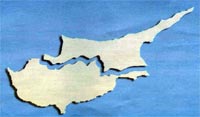
After the 1974 invasion the island of Cyprus was partitioned.
Greek Cypriots from the North and Turkish Cypriots from the south became refuges in their own homeland. And although the situation seemed untenable, it held for a very long time. The island remained divided against all the rules of logic and international affairs.

The North declared itself an independent state that nobody other than Turkey recognised as legitimate. The world just ignored it. But it didn’t go away.

I grew up in Greece, where the North was always referred to as ‘Denktaş’ fake state’. And although Denktaş is no longer at the helm, the North remains a fake as far as the Greeks are concerned.
For the Turks, in Turkey or in North Cypris, that is – unsurprisingly – not the case. The North has a name and its name is KKTC (kakateje, amusingly) Kuzey Kıbrıs Türk Cumhuriyeti ‘the Turkish Republic of Northern Cyprus’.
What’s in a name? Claims to legitimacy and aspirations for recognition, that’s what’s in a name. A clear affiliation to the mother state (the Turkish Republic), a claim of ethnic ownership of the land occupied and an appeal to democratic legitimacy in the form of a Republic of their own. A name that claims ‘we are genuine even if the Greeks think we’re fake’.

But the name didn’t do the trick.
The rest of the world averted their eyes, discussed ‘the issue’ at UN summits and largely pretended the North did not exist.
Sure, Turkey got a slap on the wrist for invading but there was no long-term damage to relations with Europe. So, many thought being ignored wasn’t altogether bad news.
Only Turkey was not prepared for a long-term occupation. Nobody had the stomach for it. They had neither the means nor inclination to sustain a patch of earth ignored by the rest of the world. But sustain it they did.

From 1974 and until the opening of the borders to foreign commerce and tourism, Turkey provided all the food, water, electricity, blankets, medication, toys, boots and shovels Northern Cypriots needed. KKTC had no economy of its own, no industry and inadequate agriculture. Naturally there was no foreign investment – direct or indirect – and the North’s beautiful beaches were out of reach for foreign tourists.
Turkey had to foot all the bills and put a big bright smile on it all as the military had decreed KKTC a priority on all levels.

Meanwhile the North was repopulated with Turkish-speakers, the South picked up its pieces and people tried to rebuild their lives. Never ignoring the big green line dividing their island, never forgetting the pain of separation.

And both sides think they are right. And both sides have stories of pain and loss. And the story changes depending on when you start the telling and when you stop. On where you stand when you tell it and where you stand when you listen. One thing is certain in every version: it is a sad story with no winners.

And I cannot for a moment blame Mr Meletis Apostolides for wanting to go home. And I understand why he went to court in Cyprus demanding his right to get his land back, now the border is open and the EU is asking all Cypriots to play nice.
And the Cypriot court said Mr Apostolides can have his land back.

And here is where the problems begin.
The land is not empty.
A British couple – Linda and David Orams – bought the land off a Turkish Cypriot and built a villa on it and, as you can imagine, they are not too keen on the idea of Mr Apostolides coming back.
So he went to the European Court of Justice where the Cypriot court ruling was upheld: Mr Apostolides can go home.
Now this is all academic, of course, because Northern Cyprus is not part of the EU so ECJ rulings do not bind the KKTC. And I don’t see them rushing to uphold a Greek Cypriot court ruling either.
But Mr Apostolides can seek compensation in a UK court and I would be very surprised if he doesn’t.

But even if he pursues this no more, Mr Apostolides’ case has set a massively significant precedent that will send chills down many spines.

And I will not pretend to have the requisite knowledge to suggest an appropriate solution for repatriation after a 36 year gap. Families that have lived and died in a once-empty house feel this is as much their home as the person’s who left it 36 years ago while fleeing for their life. Maybe it is. When ownership becomes entangled with morality and history there is no straightforward answer.

For a foreign investor, however, things are simpler and they boil down to this: like your daddy used to say, there is no such thing as a free lunch.
When something looks like too much of a bargain, you should always wonder why that is.
A beach-front villa in Northern Cyprus is so much cheaper to come by than its counterpart in the Marbella. I wonder why?

For 36 years Europe has ignored Northern Cyprus. We pretended it was a black hole. No flights landed there, no commercial relations existed, no goods were imported directly.
But in the last few years things have relaxed. Tourists, merchants and speculators have all descended since movement in and out of Northern Cyprus became possible.
And nobody noticed that nothing had changed in the status of KKTC. Still nobody recognised it as anything but occupied territory. It still had no standing, no membership in international organisations, no part in treaties and alliances, no international presence whatsoever. As a state, it only exists at home.

But investors, sun-hungry Brits and various land developers did not want to get bogged down in the political detail. Such a shame that this beautiful place was closed off for so long, they thought, and aren’t I lucky to be getting in first?
With cheap land up for grabs, investors rushed to beat others to it without stopping to think about ownership or legal redress.
Otherwise known as ‘the catch’.
You are buying land in a country that does not exist as far as your own country of citizenship is concerned. What are you going to do in case of a dispute?
Believe in the power of the dollar, is the answer.
The borders have already been opened to trade. This means that methods must have been found to resolve resulting disputes, so we must be fine, let’s go invest in cheap land.

Yet there is no such thing as ‘empty land’. It’s been centuries since that was last true – and even then it was dubious. Land always belongs to someone. Who did yours belong to before it was sold to you? In most cases you don’t really care.
Unless you are buying in a former war zone.
Unless you are buying in an area famous only because of an invasion and corresponding population displacement that occurred in living memory.
All I’m saying is in Northern Cyprus, you should care, because these guys may want to come back.

With Cyprus ‘peace’ negotiations being on the news pretty much non-stop since 1974, people became jaded about the possibility of a real solution, but nobody forgot the war, the division, the refugees. Until the refugees' houses went up for sale when everything was forgotten in the face of a good bargain.

With population displacement things are difficult and I do not envy the task of the judge that should decide to evict families – some times, though not always, refugees themselves – because the original occupants – also refugees – want to come back. People pitting their pain against each other trying to figure out whose tragedy is worse, whose right strongest. People in each other’s home, not everyone wanting to return.
That is hard.

But with an investor who grabbed the bargain not stopping to think about the complications, not caring about the implications, not stopping to wonder about the ‘catch’, well in their case, they took a risk. They gambled on the politics remaining conveniently unresolved, they gambled on people not wanting to come back. They staked their money on a bad situation staying bad. And they lost. But at least they lost after taking a conscious risk. And if they didn’t pay attention to the small print, the risk factor, then they only have themselves to blame.
They should have paid more attention to their daddy when he told them that this is the problem with bargains, there is always a catch.

Thursday, 23 April 2009

Remind me again – who did you say are the good guys?


Ah the Cold War. We knew who the villains were, we slept soundly in the knowledge we were with the good guys and James Bond movies had blissfully uncomplicated plotlines. Ok so that last bit hasn’t changed. But everything else has.

Now did I actually sleep soundly thanks to the Cold War?
No, not really.
I personally lived in constant fear of nuclear annihilation and could not possibly figure out why that terror of a man, Reagan, was supposed to be the good guy ahead of cuddly, smiley Gorbachev. But I was barely 10 when perestroika started so I am obviously nothing to go by here.

Still the fact remains: those who thought they knew where they stood with the cold war can say that no more. Sure, the Arabs are today’s bad guys. And they fit into the civilisational ‘us vs them’ battle over liberty and ‘our way of life’ (as well as banal questions of military supremacy and global power).
But not all Arabs are bad, now are they? Some are friends. But how do you tell them apart? And then, of course, those who are foe are not alone, are they? So many other bad guys to keep an eye on. Plus, this new generation of bad guy is very mobile. You don’t know where to point your missiles any more.
Add to that the fact that there are all sorts of allies we don’t really like all that much and you have a right headache in your struggle to safeguard freedom and the way of life we were talking about.

Take China for instance. Now that’s a good subject for someone interested in freedom, fairness, justice and democracy. A trading partner, of course. So we try not to bug them too much. Although, if truth be told, we are not too fond of them. Or their human rights record. Or their tendency to execute people en masse (and then sell their bodies to the West to be used in art exhibitions of dubious taste. Yes, yes it’s the Bodies exhibition I am talking about and, yes, I am squeamish). And now China has created an ever more degrading, even less controlled and monitored and even more outrageous way of killing off its own people: the mobile execution vehicle, the death-mobile, a van that can come to you and administer lethal injection in your own location. Trivialising life and death and laughing in the face of UN representatives speaking of China’s ‘improving human rights record’.

But stop press for a moment.
Have you thought that China’s record may well be improving, not out of any concerted effort to democratise, liberalise or play nice but simply because everybody else’s record is deteriorating at the speed of light?
I’m sure you all read the articles earlier this week – the CIA waterboarded two suspects 266 times during interrogations. Now 9/11 plotter Khalid Sheikh Mohammed and alleged terror commander Abu Zubaydah are bad guys. But that used to mean that they were prone to do things we wouldn’t do, us being the good guys. Thieves are bad because stealing is wrong, murderers are bad because life is sacred, rapists are evil because violation and violence is a sin, a crime and an abomination. So we are the good guys, not because we are victims of badness but because we wouldn’t do what bad guys do. Right?

Then explain torture to me, will you?
And before you tell me that Obama – blessed be his name – has banned waterboarding, let me tell you that it was happening till 2 months ago and, as Obama has not instructed a wide-spread inquest and purging of the CIA, waterboarding will stop but torture won’t.
Because 266 instances of waterboarding on 2 people says one thing and one thing alone: it happened a lot. And that, in turn, tells us an awful lot of things about how the CIA go about interrogating bad guys. And none of those things are good.

Now if you are of the ‘an eye for an eye’ school, you obviously disagree with me. Especially as we have now seen memos outlining how medical experts prevented waterboarding from causing severe mental or physical harm to the subject. So it’s not even an eye for an eye as we keep them alive.

Is that the measure of our humanity, then? Ensuring the pain doesn’t kill the suspect?
When did ‘who we are’ stop mattering?
Because who you are is measured half against what you do with you life and half against what you refuse to do. So, no, torture is not ok. Even if you have the worst of villains sitting across the interrogation table from you. And it’s not ok for three reasons:

1. What if you are wrong? What if hours, days, years from now you find that the guy who looked so evidently guilty on paper actually wasn’t? What if?

2. Revenge is not what our legal system is based on. Revenge is a bad motive and a bad reason for action. Revenge leads to the dark side.

3. If who you are entails a capacity and drive for violence, inflicting fear and pain on a defenceless – however horrible – human being, then you too my friend are one of the bad guys. Not as bad, perhaps, but bad all the same.

And making waterboarding illegal far from solves the problem
Because, don’t tell me that, when not using waterboarding, the CIA just had stern chats with their charges? And don’t tell me that, since Obama is not prosecuting any officials (not those who devised the policies, not those who carried out the interrogations, not those who failed to stop them) there will be a real change in how the supposed good guys interrogate the suspected bad guys?

And before you tell me that all’s fair in love and war, tell me how turning into what you are fighting against helps protect what you are fighting for?

Some fear that taking techniques off the table will make the enemies even more daring. More daring than what? What’s more daring than a suicide bomber?

And while experts debate whether torture ‘works’, whether accurate confessions are exacted through the medium of pain and the associated panic simulated drowning would cause, I maintain that this is not the point.
As a citizen, as a person, as an one-time ‘expert’ I refuse the ulta-right dismissal of the anti-torture argument as naïve and stand by my original proposition: humanity and morality cannot be fully separated. If you stand against the bad guys, don’t be a bad guy. If, in fighting a war, you compromise what you are striving to protect, you are your own worse enemy. And if you are fighting for freedom and democracy, well, then you can’t agree with Obama’s decision not to prosecute.

The point is that good is as good does. And no matter what desperate times call for, whatever popular wisdom absolutions you can think up, the fact remains: good guys should act like good guys, all the time, under any circumstances.
Even when doing so is difficult.
Particularly when doing so is difficult.

Monday, 20 April 2009

Why the folks running Greece cannot possibly be human


I have this theory.
That three things set humans apart from other animals: our ability for reflection, abstraction and compassion.

What do I mean?
I mean that unlike other animals, humans can deeply reflect on their behaviour, on life, on the universe. We have an ability and often a need to link the dots, poke in the shadows, truly seek to understand how things fit, why things are the way they are, why things feel the way they feel. Why did so-and-so do this? Why was I left feeling this way?
On top of that, we can do all this in the abstract. We can think about our own liberty and freedom writ large. We can think about rights, ethics, social reform. We can write poetry and debate religion. We can deal in things that cannot be touched or seen and yet we feel strongly about them.
And, most important of all in my mind, we are capable of compassion. Not just the fierce love of the lioness for her cubs. Not just the acute territorial protectionism of a wolf for his pack. Compassion. For complete strangers. On grounds of our shared humanity.

So, after thinking about it at length, I have concluded that, if my taxonomy is taken to its logical conclusion, we are left with only one option: the people running Greece are not human as they demonstrate no ability to reflect, no capacity for linking up the abstract with the concrete (the law they are passing with the problem they are trying to solve, say) and above all, no compassion whatsoever.

Let me demonstrate.
Mr Markogiannakis – successful lawyer, public prosecutor under the dictators and high and mighty within the current government. If he is not proof enough in his continued service that our leaders don’t reflect, let me give you more. He is one of the forces behind the stun guns our policemen carry – notorious for causing permanent health problems or even death – and is currently clamouring for the hire of ‘foreign’ policemen with the express job description of informing and keeping an eye on their compatriots, saving the day by arresting scores of illegal immigrants selling home-made CDs on street corners
Leaving aside his belief that illegal immigration is Greece’s most pressing problem at the moment (being stupid, sadly, fails to disqualify him as a human), his proposed solution fails to even for a moment consider what sort of society he would be building if the measure went through. No abstraction. He fails to consider how relations within the force and between the force and the community would fragment, sour and militarise. No reflection. And he fails to see – or fails to care – that this measure is preying on the poverty and despair of many an immigrant who would agree to anything that would feed their families in an honest, if not honourable way. So compassion is out the window too.

The really bad news, of course, is that Mr Markogiannakis is not alone.
Our glorious police force demonstrate a pitch-perfect ‘pack mentality’ looking after their own, covering up trespasses, crimes, violations of the law and police code of conduct. Evident is an inability to think in abstract terms of public service, order and an active contribution to democratic governance. Evident is their total lack of compassion for those they are meant to protect. Evident is also a total lack of willingness to reflect on their own conduct.
A recent study revealed that 4 or 5 policemen go down every year on charges of drug and people trafficking, blackmail, pimping and murder. That’s a tiny number in a corps that is notorious for its corruption. Yet even these few invariably come back into the force, having lost a few months’ earnings.
With more and more cases of evident police brutality being written up as people ‘beating themselves up’, tripping and, of course, suicide, ‘looking after one’s own’ is not just a figure of speech. The boys in blue don’t just keep an eye out for each other. They take out any eye that witnessed wrong-doing in a fierce protection of the pack.

Now ‘looking after your own’ is a natural instinct. Meerkats do it. Hyenas do it. Policemen do it. All humans do it, if we are honest. But they don’t do it to the complete detriment of everyone else. That’s the difference between hyenas and humans living in society. The latter know that survival does not need to be a zero sum game.

And while I’m at it – the priests? Not human either.
Sex scandals, appropriations scandals, land sale scandals and pure theft from charity coffers. Wanna talk compassion now? Wanna talk reflection? Why am I here, why am I wearing this funny black dress and what was it I set out to do?

Animals live meal to meal.
When humans have to live like that, we feel a crushing sadness as this life robs them of the basic tenets of their humanity – the ability to make complicated choices, the ability to live in the abstract, the luxury of showing compassion which you just don’t have when your own belly is empty.
But when you are fed, watered and sheltered from the elements, abstraction, reflection and compassion are possible. And essential.

Which brings me to the subject of our prime minister.
Well-fed, undoubtedly. Safe, warm – even though a trifle tired.
He is in a position to engage in reflection, abstraction and compassion. And yet he does not. He allows his government to pass laws that at best fail to address the problems he has to solve and at worse manipulate society closer and closer to a repressive regime.
There are three options here.
Option 1: his ability for reflection and abstraction is impaired because he’s dumb. That doesn’t make him any less human although it does throw his suitability for the post he is holding into sharp relief.
Option 2: the lack of reflection and compassion suggests he is not actually human. And that explains a lot.
Option 3: he is reflecting all right. And he has a perfect visualisation of where he is taking us, so his powers of abstraction are unimpaired. The slow but sure descent into a controlled state of fear and state repression is part of the plan and the prime minister and his cronies are simply members of that species that can think like a human but not feel like one. Abstraction? Reflection? Yeah, sure. Compassion? No, not today.

And here we are, trapped in a weird fairy tale, a work of science fiction, with a dark and sinister plot, unexpected twists, beasts, demons, battle scenes, plenty of villains – and no good guys.
But if this is a fairy tale, and having demonstrated that we are governed by wolves and ogres, are we not due a prince to slay them all roundabout now?