Friday, 30 October 2009

When 'every little' doesn't help


'May you live in interesting times'.
That, says my beloved Terry Pratchett, is not a blessing. Rather it's a bit of a curse, if you think about it. And there is no denying that we are now living in interesting times. And there is no denying that's not all that great. But that's no excuse for totally losing all sense of perspective.

We are scared.
Of terrorism. Of pedophiles. Of swine flu. Of the E coli 0157:H7 virus and other pathogens carried in poorly packaged or poorly cooked meat. Of Nick Griffin and hate preachers. Of racists. Of Islamic fundamentalists. Of sounding racist. Of our own shadows.

We are scared at the citizen level and we are scared at the government level. And what do we do about it? If you look through the papers of a day, you may well come to the same conclusion as me: what we do about it is kick frantically to all directions, keeping clear of the heart of each issue but making enough noise to look like we are doing something. When all we are doing is making noise. And noise is rarely a good thing.

Now as you know, I live in Britain so my examples are local yet I fear that, no matter where you are, similar things are happening every day: a sense of impeding hysteria, an overwhelming sensation that we really do not know what to do to prevent bad things from happening so we'll just try to allow few things to happen full stop and thus play the numbers game.

We all laugh when we see airport security staff putting children's plastic sandals through the scanner. Laugh but don't stop them because you never know and better to be safe and late than sorry and dead.
But what is the outer limit of caution?

Britain's tabloids have gone wild this week as parents in Watford are no longer allowed to supervise their children in playgrounds unless they have undergone criminal records checks. Vetted 'play rangers' are to supervise children instead of mums and dads.

Why? Because the case of Vanessa George has sent shock-waves through the nation. She is a paedophile. She is a woman. She is a mum. That means the demographic of potential dangers to children just widened to include absolutely everyone, so absolutely everyone is banned from playgrounds and here's to hoping that whatever tests play rangers are subjected to are the right kind and perverts don't creep through. I would still personally prefer to know that each kid was looked after by his or her parent. And that parents are keeping an eye on each other. What the hell. I would like to know that when I have kids I will be allowed to keep an eye on them myself.

But with a recent case of suspected rape of an eight-year old girl by two ten-year-old boys, stunning us all into silence, the only truth is that we really don't know how to keep our kids safe and putting them in a glass jar may well be the only way forward. Because if our children are not even safe from other children, then what is safe?
A glass jar. Safety through separation.

Now, I don't have kids. But I'm guessing, in light of recent events, if I had kids and was not allowed to keep an eye on them in the playgrounds, I'd just keep them away from the playgrounds and be done with it. Was that what the council was going for? I'm guessing not. But that's what they'll get. Because a blanket policy of considering everyone guilty until proven innocent is never going to bring about good things. Still how can we expect Watford council to maintain a sense of perspective when everyone else has lost it?

A woman in labour asked for 'ethnic minority' staff to leave her bedside, at a hospital in Milton Keynes earlier this week. It is not clear what particular minority she objected to (although according to reports, it was one group in particular she objects to) and it is not clear why she objected to them being present. What is clear is that the hospital refused to accommodate her. So the hospital acted as they should. Her request was racist, unreasonable and by the sounds of it unreasoned. The hospital overruled her and she went home a while later with a healthy child.

Now she could be facing action in a county court on grounds of discrimination. And although I object to her racism and find her ability to demand racial segregation between contractions faintly amusing, I can't help but think that the thought police are on the prowl. I disagree with what she stands for. But she didn't act on it because the hospital did not let her. So what would the trial be about? And why is there a threat from the Equality and Human Rights Commission that the hospital may be under suspicion as well, when no discriminatory act was perpetrated by hospital staff?

I fear the answer is simpler than we are comfortable with: this is the sort of problem we can deal with, be outraged by, 'handle', judge and close. Only it doesn't solve a thing. If anything, it exacerbates the situation. The likes of Nick Griffin can spin the whole 'no place for Britons in Britain' tale and the bottom line remains that we have lost perspective because the big issues are just too big for us to deal with so we contend ourselves with the contained little issues thinking it's better than nothing. Only it isn't. It's actually worse than throwing hands up in the air and going 'this is too big and I can't fix it the way I've been fixing things hitherto. I need to think, I need to change'.

If you are not sold yet, here is another example:
An elderly lady in Norfolk wrote to her council to complain about a gay pride march in her vicinity. I personally enjoy Pride and everything it stands for and tend to join when I can although I am not, myself, gay. Nobody cares. Pride, as I know it, is inclusive and open and most participants would welcome elderly ladies from Norfolk if they wanted to join in the festivities. But they would equally accept her right to refrain, even to disapprove of them. Each to their own and all that.

And a letter to the council is a rather innocuous – if pointless – form of protest that will not have any real effect on Pride. On this occasion, however, it may have a real effect on the person complaining as the council wrote back to the homophobic old lady warning her that she may be guilty of a hate crime. The matter was passed on to the police and I expect it to be dropped but the point remains: with real hate crimes committed every day, why is a narrow-minded pensioner exercising a democratic right to free speech targeted? It could be because a council employee was not thinking or was misguidedly over-zealous. It could also be that she is simply an easier target than say the thugs who still engage in gay bashing in the centres of our towns. The same way that a bigoted mother in labour is an easier target than the police officers whose routine racism victimises young, black males as a matter of course as the Guardian recently revealed.
And I use 'revealed' very loosely here.
Because we all know.
We know racism is a violent reality for many people in our communities. Homophobia is spectre in many lives. Real, physical dangers to people's bodily integrity and sense of safety.
And yes we do know that child abusers of all genders and all ages are also abroad.
We know all that.

The question is what do we do about it?
And all I'm saying by pooling together three largely unrelated examples is that we are currently doing NOTHING. Because bashing soft targets and imposing blanket bans is not making our society more tolerant or safer, it is just making it more hypocritical, harder to live in and less likely to resolve the real issues underlying the violence and sense of threat that seems to hide in every dark corner.
Making every person a suspected paedophile does not make children safer.
Punishing unsavoury opinions does not make hate crimes less likely. Making opinion - however unpalatable - a crime makes us the bad guys. It makes our democracy shambolic while race and homophobic crimes - actual acts, the stuff the law should target - carry on occurring because they are not properly prevented or followed up.

And creating a society of division, mistrust and fear will not make anyone safer.
So no, ladies and gents, every little does not always help. Particularly when we are trying to navigate through 'interesting times' without throwing everything we have achieved through decades of social struggle, democratisation and liberalisation overboard.

Thursday, 22 October 2009

What fearing Nick Griffin tells us about ourselves


Why is everyone so scared of letting the leader of the British National Party speak during tonight's Question Time show? Why is everyone so worried about what it will signify, to take a seat on a panel next to him, in obvious opposition to him?
Don't give me that crap about legitimising him. What additional legitimacy does a democratically elected representative of the people need?

Tell me what's really on your mind people.

Are you afraid that cool, articulate, unflustered, racist Nick Griffin will get his despicable point across better than the representatives of the political mainstream?
Because that is what I am afraid of.
I am afraid he will be calmer than the other guys.
Less arrogant in the eyes of the average viewer.
I am afraid he will be more articulate and more convincing, keeping things real and relevant, never using abstractions and generalisations. I am afraid he will manage to reduce big issues to small, personal fears in a way that is non-patronising and almost self-evident.
I am afraid he will do all that without insulting any of his fellow panelists while they will be struggling to hold back cries of 'begone you disgusting racist slug'.
And I am afraid that the other side, the non-racist side, our side damn it, will be left speaking in generalities, attacking his racism but offering no coherent answer to counter his concerns and offering absolutely no counter-solution to his own objectionable measures.

So the problem is not him. It's us, folks.

Let's call a spade a spade.
Immigration is not a subject most parties are comfortable with. Invariably, even parties on the left are in favour of controlling the borders and not throwing the gates open to all and sundry. Increasingly centre and left-of-centre parties grudgingly accept that freedom of speech will not deal with radical Islamist preachers in our midst 'organically' and a bold fresh look is needed asking where their liberty infringes on someone else's – not on a community basis but on an individual basis, you know, the way we used to apply the law all these years before this became such a 'hot potato' issue. And then there is the issue of building community, and living together in all our multi-colour, multi-faith, multilingual splendour.
And many left or centre-left politicians are not comfortable with immigration debates because they rightly consider these three issues distinct and separate and find that more and more people don't and in fudging the debate these people confuse the matter, create panics and allow concerns over hate preachers to poison community relations.
Nick Griffin is one of those people.

He is not afraid to talk about immigration. For him the distinctions are distracting and the problem boils down to what moves and scares the individual citizen. And his solutions are stark, simple, bold. And racist.
But what is the other side counter-suggesting?
A convoluted narrative of freedom, multi-culturalism and necessary border controls, constant reminders that the problem is multi-faceted and many-tiered and above all not simple. All solutions offered are halting, nuanced, complicated, careful – because one should not confuse the issues. And rightly so. Still, I fear that Nick Griffin has this one wrapped up if 'straight talking' is what the audience are after.

Holding a contradiction in his mind is not a challenge for Mr Griffin who is both articulate and clever. He understand the contradictions and in them he sees the weakness his opponents most suffer from. This contradiction, in his hands, stops being innate in the subject and becomes a weakness in his opponents' political will and solutions' agenda.

What do we have to counter that? I am using 'we' in the loosest possible sense here, siding with the people who disagree with Nick Griffin even if that is the only thing we agree on.

What have we got?
Don't forget Jack Straw is sitting on our side.
Griffin is articulate, confident and confidence-inspiring. He sounds like he commands the issues and can effortlessly pare them down to their essence. Even though that essence is tainted, one-sided and heavily nuanced, he appears to be offering common sense summaries and bold solutions. Jack Straw is not and does not.

So why are we so scared of letting him speak tonight?
Not because we disagree profoundly with what he has to say – that, if anything, is reason to take him on, thrash it out, expose him to the public, ensure the other side is heard.
Not because we fear what his effect might be on the polity – because he is already in the polity so it is too late, plus we already know that enforced isolation and silence creates heroes and not villains.

It is because we are afraid we can't match him, blow for blow, for the hearts and minds of the viewers. And that is terrifying.
It's because we know Nick Griffin is as popular as his opinions are objectionable. And we know we have all the good arguments. But we don't have a Nick Griffin on our side to deliver those arguments in level, even-toned, convincing, populist nuggets.

So we are scared.
Of course we are scared.
I, for one, am terrified.

And I don't know about you. But I will be glued to Question Time tonight. Munching pop-corn, mumbling to myself and hoping against hope that Griffin will have a bad day, that he will lose his cool, that he will sound to all tonight as offensive as he sounds to me all the time. And that Baroness Warsi, Chris Huhne or Bonnie Greer will pull an ace out of their sleeves explaining why a world where Nick Griffin's opinions are not put into practice is a better world for all. And that Jack Straw stays silent. Wishful thinking but what the hell, while I'm at it I might as well.

I just hope that the arguments for our side go further than 'Nick Griffin, you are a racist' because he will slam them down and go for a home run before anything else has been stated. Not because he is not racist. But because pointing out the obvious in a petulant way is not good debating.
Telling him his policies are wrong because he is a bad person is a non-sequitur that makes us look like fools with nothing else to say and gives him the moral high-ground.
And that's the last place you want to concede to your neighborhood racist. He is already self-appointed defender of home and hearth, hand him the moral high ground on a platter and what have you got? A populist, playing on everyone's most closely guarded fears, articulating their concerns about safety on their streets, jobs for their children, a culture they call their own, who is victimised by the very same people who don't address the people's worries, the very same people who have no counter-argument to throw his way than an insult.
Attack him on who he is rather than what he says and you've driven people into his arms in droves.

You do see where I'm going with this right?
The urge to slap Nick Griffin lurks in us all. But that is not what is called for today.
We need to take him on the issues or go home. Blow by blow, line by line. Address the same questions, counter his conclusions, offer alternative solutions.
Speak to the same people he is speaking to on the same issues.
He claims he is of the people, for the people. Do we all realise what that means?
If he is addressing a struggling, white manual labourer in Bradford, we cannot be addressing a professor of ethics at Edinburgh. If he speaks about protection against radical Islam, we cannot be addressing comparative theology scholars who understand that the Islamic Umma is a community of peace ergo Griffin is wrong.
Take him on, damn it. Being more highbrow than him is how we lose this battle not how we win it.
Surely, career politicians can do this, right?

So what are we afraid of?
Are we afraid of 'the people'? Their inability to see through him and know better? Then we should all go home because no democrat is afraid of the people. You either trust in the people or join the populists a la Nick Griffin.

So if not that then what?
Could it be that although we disagree with Griffin we have absolutely no ideas on the matter he is about to challenge us on that we are comfortable with? I sincerely hope not. But I can see no other explanation that makes sense. We are afraid of Nick Griffin because he's calling our bluff and, other than grand ideas, the political mainstream have nothing to suggest that makes sense to their voters.
In which case we should be afraid of Nick Griffin. Very afraid.

Tuesday, 13 October 2009

Forget Wonderland. Through the Looking Glass, lies Turkey


If asked to take a guess, would you suppose that:
A western-oriented, secularist, aggressively modernising party would be in favour or its country joining the EU?
An army would be traditionally conservative and sympathetic to religion and tradition?
A populist government would always make sure they carry the people with them?

Yeah, you would, wouldn't you?
Only if you were talking about Turkey you'd be wrong.

In Turkey, the populist Islamist government currently in power is in favour of EU accession and the secularist, traditionally westernising opposition (the CHP, Atatürk's own party) are vocally against all reform efforts and, although theoretically in favour of accession, effectively blocking the path to EU by demanding that the EU 'respects' Turkey in ways that make no sense to the EU whatsoever. Not that the Euros mind. All delays to Turkey's accession are well and good by Brussels, but that's another story altogether.

Meanwhile the AKP is locked in a battle to the death with the country's high-profile, aggressively secularist military who, quite frankly, loathe the AKP and everything it stands for and are – possibly, maybe – trying to undermine the government quite actively. A series of leaks (more on this in a minute) have caused the army's otherwise impeccable reputation to suffer and for the first time in the Republic's eight decades, the people are losing faith in the military and are beginning to see the value in purging politics from military influence and putting the soldiers back in their box.

The AKP, of course, agrees and has been trying to do just that for the best part of a decade now. But do they manage to carry the people with them?
No sir.
They manage, magically, to make the people feel excluded from proceedings and by-passed as the government is acting on what everyone in principle agrees upon but without any public debate or evident deliberation. And although agreement over the bottom line is there, these are vital questions affecting the nature and future of the Turkish polity and reform without deliberation is unacceptable in principle, agreement notwithstanding.
You'd think that for sheer ease the government would have capitalised on the popularity of the idea, being populist and all. But paternalistic habits die hard and even populists take a leaf out of the book on old school Turkish politics traditions.

Under normal circumstances you would expect the opposition to make the most of the government's failures roundabout now. But don't hold your breath.
The opposition is even more paternalistic than the AKP who have nothing to worry about because the CHP seems hell-bent on working itself into extinction one statement at a time.

First of all, the CHP are perceived (and dismissed) as a mouthpiece for the increasingly discredited military. This, at least, gives them something relevant to say as, when not saying what the generals want them to say, the CHP have little to say that is of any interest to the people. Out of touch? And then some as the CHP have been outside power for the best part of two decades and once, after the 1999 elections, also outside Parliament. Popularity is evidently not the word here but has the CHP leader Deniz Baykal resigned to let a more credible (not to mention likeable) candidate to take the reigns? Like hell he has.

Now being perceived as the mouthpiece of the military wouldn't have been all that bad had it not been for a series of recent leaks and almost-scandals that show the military getting really jittery, planning coups, plotting against the government and against powerful religious brotherhoods, particularly against the Gülenists. Obviously, none of these plots have come off – or I would have been blogging about that instead – and most of them have been stopped by the military leadership themselves but the fact remains that people believe the military is taking things too far. All cries that the memos are fabricated or that the army purges itself fail to drown out the feeling that the time is right for change.

The people want it.
The Gülenists want it.
The AKP want it.

So why is it not happening?

Well. Bits of it are happening. Change is afoot and has been non-stop since 2001. To a Turkey buff like me the changes that have come to pass in the past 8 years are immense, mind-boggling, 'I never thought I'd see this' type changes. But to the naked eye, things are not as great. To the close-up look of a Turkish citizen or the bird's eye view of an external observer, change is slow, sluggish, halting, half-hearted and above all: a bit of a sand-castle on the surf. Because you can reform all you want, unless you tackle the constitutional foundations of the state, it's like selecting toppings before you make sure you have enough flour to make a pizza.

And what I mean by that is this: for all the bravado and all the radical mini reforms, the AKP's policy has been a balancing act so far. Pushing change as far as it can go before things snap, break, shatter and come back to bite you in the proverbial rear. The AKP's genius – if you will permit me the term – is that they have managed to play on all their opponents' weaknesses while using their opponents' ideas to further their own cause. And it has worked. It has worked well enough to keep the AKP in power, to keep the EU happy and the accession process ticking over. It has also helped accomplish important and much needed reforms and keep the people on side. Most of the time.

But a balancing act rarely bodes well as a sign of decisive political will, which is what fundamental constitutional reform would entail.
In short.
Turkey's constitution was written by the army in the 80s. It reflects their ideas, it promotes their priorities and it upholds their role as guardian of the Republic.
Amen.
This constitution has been massively amended. It is now a patchwork of ideas and a lot of the 'in your face' militaristic provisions have been removed. So what? The heart of it remains and it will always do until someone has the political balls to say 'enough of this, let's make a new constitution that tells the soldiers what to do rather than the other way round'.

But who is going to be that guy?
And assuming we get 'that guy', where on earth will he start?
Where do you start in a political system where nothing is what you expect, allegiances are very idiosyncratic and nobody ever says exactly what they mean because there are laws against that.
And even when things seem aligned, groups seem to agree, consensus seems almost inevitable nothing ever happens like you'd think it would. Because you are through the looking glass and nothing is as it seems.

And as with the fairytale, so with Turkey, while the white rabbit, the mad hatter and the queen of hearts indulge in their games, express their quirks and pursue whatever takes their fancy, it is the common folk that have to dodge the Cheshire cat, ensure they hold onto their heads and try to build for themselves a semblance of normality despite it all.
And you can't help but think that, given the circumstances, 'that guy', 'those guys' the people who can visualize and implement real change are exactly the people who are trying to get past the cat and the deranged queen of hearts. The people who could change it all are exactly the people who are too busy trying to build a life, despite it all.

Monday, 5 October 2009

Cry, the beloved country


I did not vote yesterday.
I live in London, innit?

Plus the election results seemed almost predestined.
Plus, I cannot legitimately bring myself to choose between the choices available and as casting a blank 'protest' ballot would simply boost the top party along its way in this curious twist of proportional representation whereby blank and spoiled ballots are added to the votes knowingly cast for the winner, I didn't vote.

But this is not a critique of Greece's electoral system.
It's not a critique of Greece's political system.
It's just a realisation, that crept up on me slowly last night as I was watching the results come in over the internet and talked on the phone with family and friends out in Greece. And the realisation is this: we, the Greek public, are like one of those girls, neglected, abused and unloved by their boyfriends but so convinced we can do no better, that we have learned to draw pleasure from the days when he isn't so bad and we are simply over the moon on the days he can muster some basic decency. And so deep is this conviction that we can do no better that, when we finally leave the brute, we end up in the arms of someone just like him because 'that's what men are like'.

How many times on the run-up to this election did you say: 'well, at least the new one cannot possibly be as bad as the last one, he may try but it is impossible to be just as bad'?
How many times did you hear: 'well now the only way is up, surely we have hit rock bottom'?
How many times did the voting public vocally and actively affirm that they considered the choices presented to them inadequate and the act of voting a mechanical discharge in the hope that further evil would be averted by removing from power the guy who so clearly failed to resolve all the pressing problems that presented themselves on his watch?

And replace him with what?
A guy the voting public had pointedly rejected twice before.
A guy who did not have the decency to resign when he should have because he knew that if he stuck around it was a matter of time before we needed somewhere to run, away from the neglect and abuse of our Nea Dimokratia boyfriend. And despite our previous rejections, when things got depserate and we had nowhere else to run, we did run straight into the arms of suitor number 2, George Papandreou: twice rejected but never actually gotten rid of.
He stuck around shamelessly and here he is now, in power.

So don't talk to me about George Papandreou's 'triumph'. Mr Karamanlis simply lost the election. He lost it with a bang, he lost it by a mile but he lost it by himself. Mr Papandreou didn't need to actively win it. He just needed to wait for power to land on his lap. As it did.

Semantics, I hear you say?
Hardly.
Negative voting of the 'I really don't want this guy, I'll vote for the other one' variety makes the lives of politicians really really easy. They do not need to campaign on the issues, they do not need to stick to the issues, they hardly need to do anything about the issues once they are in power. All they need to do is be perceived as a better choice than the other guy. So on this occasion Karamanlis had sunk so low in people's estimations that Papandreou could have turned up on the day without campaigning and he still would have won by a landslide.

'Ultimate personal vindication' for Papandreou, says the front page of Eleftherotypia today.
Give me a break.
They feed us this crap and we sit here and take it. As if the election results prove that Papandreou was right not to resign after his last defeat – and the one before – as if this proves we were always coming back to him. As if the poor choice and the chronic damage it is doing both to our political culture and to the country as such is not even worth mentioning. Because when it comes to prime ministers and boyfriends, they are all much of a muchness and prince charming has been dead for decades.

At least Karamanlis resigned, so that is that there and on we go with a new face and old ideas when the time for their leadership election comes. Even more mediocre suitors to choose from. But maybe the baseline will be higher. Maybe Nea Demokratia's next leader will realise that if you have been in power two years, during which all you have achieved is beaching the economy and watching idly on while riots raged throughout your country, well if those conditions are met then you don't call an election unless losing it is what you are after.
And maybe that is what you were after, Mr Karamanlis, you were tired after all and the glamour wore off pretty soon this second time round, didn't it?

So what have we got?
A populace that is dispirited, tired and completely disillusioned. A populace that puts up with the neglectful, abusive boyfriends because it is convinced that mediocrity is 'as good as it gets' and the goal is to swap one inadequate man with another to avoid the worst of it and keep afloat.

This makes the job of running for elections that bit easier. The less your voters care, the less you have to do to convince them. The less your girlfriend expects, the more you get away with.

Meanwhile, the parties of the left are losing support – not fast, but noticeably – and LAOS, the racist, ultira-nationalistic, uber-rightist party that seemed like a bad joke when it first hit our TV screens is gathering votes – fast and noticeably.

Does that matter?
Damn right it does.
Because some people vote for mr Karatzaferis despite his politics, for his affability – and that is simultaneously stupid and irresponsible. But many are voting for him for his politics and his affability: at least he cares, they say, and maybe he could have handled the riots better (as the extreme right are want to do) and maybe he would have handled the economic crisis better, by clamping down on the illegal immigrants because, didn't you know, they brought down the international banking system and are to blame for Greece's ailing economy.

So maiden Greece assessed her available suitors and, convinced she can do no better, is salvaging what she can. Taking the power mantle away from the guy who failed her most recently and giving it to the guy whom she has repeatedly rejected but who won't take the hint because he knows, he just knows her expectations are low and if he waits long enough, if he just waits long enough.

And he did. Wait long enough. And here we are in his arms. In fact, so eager were we to get rid of Karamanlis, that we rushed to the polls and gave the new guy a majority that means he doesn't need to consult with anyone, within or outside parliament, setting him up to be our new abusive and neglectful boyfriend, convinced that we can do no better.

Thursday, 10 September 2009

Blogging for democracy


World rejoice. I am back.
I've been offline for a whole month and, although I am sure you missed me and, I assure you, I missed you back, I must report that it is possible to live away from a computer. For a few weeks, I caught a glimpse of a parallel universe in which my friends were not scattered the world over, my job did not rely on shared documents and email and day-to-day activities did not depend so totally on the internet.
You guessed it. I was on holiday.

In real life of course staying away from the computer is not an option. Work. Checking cinema listings. Submitting my tax return. Downloading the latest TED talk. Reading the papers. Chatting to friends. Grocery shopping. Job applications. Travel bookings and theatre reservations.
What did we ever do before the internet? But really, what are we really doing with the internet?

Bear with me.
I was walking through Athens a few weeks ago till a gaggle of teenage tourists caught my eye.
'The Pnyx. Where the hell is the Pnyx. I don't see anything' said one.
Behind you, you moron, thought I.
But I didn't say it. Because really, the Pnyx is not much to look at. Places where real business takes place rarely are. The Pnyx, or what is left of it, is easy to just walk past and, in the dark, it looks less like a world heritage site and more like an empty lot. Which, nowadays, it is in more ways than one.
So the tourists walked on, having decided that their guide book was rubbish and it was time for a drink and I was left thinking that they are not alone in having totally missed the Pnyx.

Athenian democracy was flawed, we all know that. But the one thing that was right about it was the Pnyx and everything that transpired there as this was where the citizens, free and equal, got to speak, openly and on any subject they wished to speak on.
Dull? I bet it was.
Every Tom, Dick and Harry having a constitutional right to go on and on and on (and on) about their pet peeve, their favourite gripe. Painful. But vital. For democracy. For community. For fairness. In the Pnyx no politician could ever claim to be 'the voice of the people'. The people would speak for themselves and tell him where to get off. The people can of course be wrong – they did, after all, kill Socrates and exile Aristeidis – but that's an occupational hazard if you are a democrat. At least back then the people had a chance to get it wrong themselves, rather than by proxy.

Democracy is not meant to be the system of good outcomes. Democracy takes care of the many. If the many are wrong, so is their polity. If the many are brutal so is their state. If the many are inspired, so is their society.
Democracy has nothing to do with the what and everything to do with the how.

For the ancients, getting that right involved leaving women and slaves out of it because they had no cognitive abilities. Do I disagree with it? Of course I disagree with it. But I don't disagree with the premise, even though it would leave me out in the cold without a vote.
Deciding who your citizens are is hard and every benchmark is arbitrary – gender, age, money, nationality, religion, race: what criteria define 'the people'?
Lines need to be drawn and it is not always obvious where you should draw them. Women today have universal suffrage while monarchs, refugees, migrants, lunatics, children and criminals don't get the vote.
Defining 'the people' is neither easy nor straightforward.
In Athens that group was narrow and closed. But at least it was equal and free. Which is more than we can say about the citizen body of any modern democracy.

In Athens only free-born, Athenian-born males of some property were part of the 'people'. The group was small. Still it had wild variations within. But once you were in you were in and you got to benefit from a system that was there to serve you. Now there's a thought.
Inequalities of wealth and status among citizens did not matter in the exercise of civic duty and the enjoyment of civic rights. Politics was the great leveller. The exact opposite of today's democracy where status, money, skin colour and connections determine power, access, influence and civic security.

Democracy in its purest form rested on three simple principles: isonomia, isopoliteia, isigoria.
All citizens are equal under the law.
All citizens have equal voting rights.
All citizens have an equal right to debate policy.

The Pnyx is the spatial substantiation of the principle of isigoria, the forgotten heart of democracy, the right and opportunity to speak on an equal footing in matters of state.

Of course, the three principles of Athenian democracy are mentioned in every self-proclaimed democratic constitution in Europe, America and, I am sure, in a few even less probable locations. We pay lipservice to isigoria: everyone is allowed to speak. Everyone is allowed to stand for election. Everyone is allowed to speak to their MP. In the UK you are even allowed to stand on a soap box and speak to the pigeons of Hyde Park Corner.
So bloody what?
It ain't the Pnyx is it? It ain't the Pnyx if nobody is listening.

Isigoria means you have a right to be listened to. Not just a right to babble.
Isigoria means you have guaranteed access to media that will allow your opinions to be heard and considered. In ancient Athens that medium was a rock near the Acropolis. Central. Good acoustics. It worked.
Today it would be an online citizen forum, a people's assembly, a rally.
Today it could be a million and one things – we have, after all, the internet.
We have it, but what do we do with it?

A lot. Actually.
Our governments may not be helping here. They don't protect our access. They don't encourage our participation. But now, for the first time ever, we don't need them to. We have the internet.
The internet is for porn and facebook.
The internet is for speed dating and spam email.
The internet is full of fascinating blogs, community portals, grassroot mobilisation sites, civil society organisations and communal action outlets.
The internet is our Pnyx.

So blog away my friends and let's get back what is rightfully ours.

And next time someone asks where the Pnyx is within earshot, I'll give them the only possible answer: it's wherever you make it happen.

Thursday, 13 August 2009

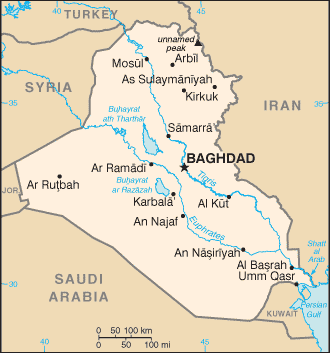
Broken record day: Iraq


July 31st, US troops roll back leaving security operations in Iraqi hands. Five minutes later all hell breaks loose. Of course that is an exaggeration but in the 2 weeks since the withdrawal of US troops there have been no fewer than 5 separate bomb attacks in Iraq.

On Friday last week, 36 people died in a series of attacks in Shia areas.
Just another day in Iraq?
Pretty much.
A couple of days ago, two truck bombs exploded in Khaznah, near Mosul. 23 dead, 130 injured.
Meanwhile, two more bombs went off in Baghdad killing 16 and injuring 80 people.

A mere two weeks after US troops pulled back leaving security in Iraqi hands, bombs are going off, taking out houses in residential neighborhoods, targeting labourers gathering for work, killing pilgrims, ensuring normal life is still not an option in Iraq.

Of course they are trying to make a point.

The attacks are extremely well-orchestrated, with bombs going off simultaneously in disparate locations. And although the bombs seem to target Shias more than Sunnis, mixed areas are hit frequently enough to make the violence all-enveloping.

The challenge to the government is palpable.
Can they handle the security situation? They say they can. But if you are waiting for the next bomb to go off you may not feel that secure. But that's another day in Iraq. It's not like anyone has felt safe since all this started in March 2003.

First it was the invasion. Then it was the insurgency. Now we hear that it's al-Qaeda. That's right. Mosul is allegedly the last stronghold of al-Qaeda in Iraq. The frequent deadly bomb blasts that have been shaking Iraq since the withdrawal of US forces are attributed to that shady and seemingly omni-potent organisation. Elusive yet seemingly to blame for all ills and all ailments.

Meanwhile bombs explode in building sites and rubbish piles. The Iraqi government says this is the last of the insurgency. The European press says this is al-Qaeda fighting on. And the Iraqis just ask themselves when will this all stop?

Early in 2003, before troops were deployed into Iraq, George W. Bush speaking to Washington Post journalist Bob Woodward (yes, Bob of Watergate fame) said that he expected that the war in Iraq would be over in a matter of weeks. Big cheese invasion general Franks concurred. A few weeks should do it.

We now know how much they didn't know then. How much they didn't understand, didn't take seriously, didn't think through. We know that the Iraqi exiles Bush's administration took advice from were horribly out of touch at best and severely biased at worst. We know that ORHA and subsequent reconstruction efforts were chaotic some of the time and shambolic the rest. We know the war was not over in a matter of weeks. And we know that although US troops are withdrawing – because Obama pledged they would – the war is not over yet. And reconstruction is but an elusive dream for all concerned.

So let's recap.
The US and their coalition of the willing went into Iraq in 2003 for four stated reasons:
1. To find and destroy weapons of mass destruction.
2. To remove Saddam from power.
3. To liberate Iraqis and bring them democracy.
4. To fight the war on terror and make the world a safer place.

So 1 out of 4.
Saddam is deposed and dead but on the rest, the scoreline doesn't look so good. Weapons of mass destruction simply did not exist and the capability for creating them was questionable at best. Iraqis are liberated from Baathist oppression but with constant violence and destruction every day over the past 6 years, liberty is not a word that springs to mind. As for democracy, we've talked about this again and again, democracy and war don't mix and while people fear for their lives and livelihoods, democratic participation and civil society are not an option.

As for making the world a safer place, well, definitions vary but however you define it and however much you stretch it, it hasn't happened.
And now they are withdrawing. Leaving behind them chaos, violence and destruction. Being none the wiser as to what it was that made the world so unsafe and so terrifying in 2001 and since.
We still don't understand so we still cannot prevent.
Meanwhile yet another country is left with smouldering piles of debris, fear and anguish.

I don't know about you, but that doesn't sound like an improvement on the general state of the world to me. And until we realise that violence breeds violence and fear breeds pain and anger, we are not going to get very far fixing the mess we are in.
Bombing it didn't fix it.
Withdrawing from it won't fix it.
Somewhere in-between must be another way, the way that makes peace an option. We just need to stop shooting long enough before we start packing to figure it all out.

Tuesday, 28 July 2009

European History X.


If I say 'the extreme right is on the rise in Europe' what comes to mind?

Neo-nazi gangs on the rampage, xenophobic orators and angry mobs, racist slogans, fear and violence? Ed Norton as Derek Vinyard running through European backstreets and various renditions of the famous teeth-on-sidewalk scene? Ed Furlong bleeding on a bathroom floor and whatnot? Right. Yes. Me too.

Yet, although racist violence is sadly occurring all over Europe, the rise of the ultra-right seems to have taken a more sanitized form this time. Suits and somber rhetoric. Anger has ceded its place to patronising goodwill and the ability to tap straight in the heart of your average euro-Joe-public whose comfort zone has shifted sharply to the right and who is eager for a politician who will defend him and his.

The latest EU election brought in more openly nationalistic candidates than ever before. And what should have been a contradiction in terms – anointing an insular nationalist to represent you in a multi-national institution – is a fact. Europe is moving to the Right.

Social scientists are not surprised. High immigration levels, a global financial crisis and rising unemployment are invariably a bad cocktail. In times of crisis scapegoating becomes a team sport and the more different you look the more likely you are to be blamed for whatever is going wrong in your vicinity.
Rationality doesn't come into it. Just as the Jews were single-handedly responsible for both capitalism and communism in the eyes of Nazi propagandists in the 30s and 40s, similarly, your scapegoat of choice is to blame for poverty, unemployment, crime, pollution and the demise of the welfare state. Add to that the appeal of blaming Europe for anything you can't directly blame your government for and what you have is a full-bodied nationalistic, anti-immigrant and anti-EU movement sweeping across Europe.

Now this is bad news in itself. The EU as a set of institutions evolved from a pan-European need, post World War II, to marshal all existing resources and cross-border institutions and fuse them into the ultimate bastion against fascism. The vision was one of pluralism, inclusion and openness. And, no, ultra-rightists didn't feature in this plan. There was no role for them in this scenario, no place at the table.

But now they have turned up for dinner and the question is what do you do with them?
You can ignore them. Pretend they are not there, hope they go away. That is what Britain did a few days ago when a government champagne reception for the country's 72 MEPs pointedly excluded the BNP's Nick Griffin and Andrew Brons. NFI-ed. There. That restores the cosmic balance and, if asked, we'll roll our eyes and say that the weakness of our first-past-the-post electoral system is that localised support can occasionally see a very unlikely candidate elected. We do assure you all, however, that there is no wider sociological significance to this election.
Thus goes the official British line.

Only there is no denying there is a wider sociological significance to this election and that significance is EU-wide. Ultra-right parties are on the rise. Ultra-right priorities are on the ascendency. Ultra-right language is in common use.

And here we are trying to figure out What Is To Be Done.

In France and Belgium the main parties have their routine worked out. When unsavoury right-wing elements attract popular support, the system colludes to keep them out. I personally kind of like that but, let's not kid ourselves, it is undemocratic to the extreme. The people have spoken, it seems to suggest, but they are talking gibberish so we'll ignore them for now until they talk sense.

But how will they talk sense if you change nothing in the way they live and the way they learn? Change is needed but change takes time and time is at a premium so rather than hatching long-term social strategy, our leaders simply ignore the misguided populace and hope for the best. Meanwhile they don't even bother to lead by example. On the contrary, they make the most of a bad situation, neutralising the bad guys or simply playing ball with them and giving themselves a popularity boost in the bargain.

Sarkozy in France, Berlusconi in Italy and sadly many others across Europe 'neutralise' the ultra-right by borrowing their language, embracing their agenda and stealing their supporters. That is seen as 'sanitizing' the extreme right because the unsavoury individuals are kept away from power, the people are kept in check – and meanwhile the mainstream is suffused with the language of antagonism, exclusion, insularity.
Le Pen was kept away from office even though he recently garnered 47% of the vote. And before you say that a small injury to democracy protects the essence of la Marianne, let me remind you that Sarkozy's social and immigration policies only differ from Le Pen's in one thing: tone.

Meanwhile, in the Netherlands, Poland and Slovakia the extreme right are colonising Parliament en masse. They know the tricks. They speak the right language and respect the law. They do not advocate violence, they do not incite pogroms. But they are using the institutions they have access to – domestic and European – to 'protect', to close, to limit, to measure, in short to push forth the agenda of the extreme right clad in a language of understanding and evenness.

The extreme right has had a make-over. Derek Vinyard is nobody's poster child anymore. The face of the extreme right wears a suit and speaks the polished and value-neutral language of power. They are here, they mean business and they have a following. And it's that last bit that nobody seems to be dealing with. Their following.

According to the Guardian the new European Parliament sports 'Hungarian gypsy-haters, French Holocaust deniers, Dutch Islam-baiters, Austrian antisemites, Italian racists, and Flemish separatists, as well as Griffin, for whom Islam is a cancer and who wants boats of illegal immigrants sunk at sea'.
And editorial after editorial laments the existence of these parties. And nobody speaks of their voters. Because those who berate the ultra-rightists never fail to canvass their voters when elections near.

Co-optation, collaboration or Berlusconi's 'big tent' party are nice ways of saying that the mainstream is happy to get into bed with the ultra-right if it means getting more votes. Berlusconi's party has thus embraced latter-day fascists and anti-muslim groups such as the highly racist Northern League. Similarly, in Poland the opposition Law and Justice party has risen to prominence by, among other things, embracing antisemitic, anti-German and ultra-Catholic messages. Across Europe, in national and European elections the Right carries the day. It may be disguised, sanitized or in-your-face, ultimately it makes little difference as when it comes to the bottom line in questions of immigration, social policy, European integration, welfare, law and order and nationalism the flavour is the same.

Europe is moving to the right because its voters will it and its politicians make it happen.

It is a bit late in the day to be wondering what is to be done. Especially when those wondering are the same people riding the wave of change and benefiting from the electoral maths of an ever-increasing insularity among Europe's voters.

Europe is turning to the Right.
That's because politicians are leading and voters are following.
That's because voters are demanding it and politicians are complying.

Europe is taking itself to the Right.
And nobody is to blame but us.
And nothing can be done unless we do it.