Showing posts with label Broken Record Day. Show all posts

Thursday, 13 August 2009

Broken record day: Iraq


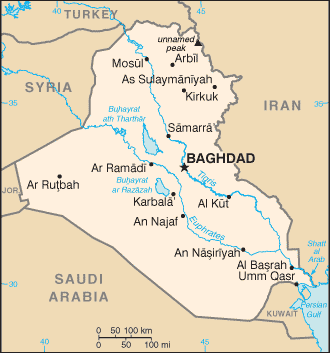
July 31st, US troops roll back leaving security operations in Iraqi hands. Five minutes later all hell breaks loose. Of course that is an exaggeration but in the 2 weeks since the withdrawal of US troops there have been no fewer than 5 separate bomb attacks in Iraq.

On Friday last week, 36 people died in a series of attacks in Shia areas.
Just another day in Iraq?
Pretty much.
A couple of days ago, two truck bombs exploded in Khaznah, near Mosul. 23 dead, 130 injured.
Meanwhile, two more bombs went off in Baghdad killing 16 and injuring 80 people.

A mere two weeks after US troops pulled back leaving security in Iraqi hands, bombs are going off, taking out houses in residential neighborhoods, targeting labourers gathering for work, killing pilgrims, ensuring normal life is still not an option in Iraq.

Of course they are trying to make a point.

The attacks are extremely well-orchestrated, with bombs going off simultaneously in disparate locations. And although the bombs seem to target Shias more than Sunnis, mixed areas are hit frequently enough to make the violence all-enveloping.

The challenge to the government is palpable.
Can they handle the security situation? They say they can. But if you are waiting for the next bomb to go off you may not feel that secure. But that's another day in Iraq. It's not like anyone has felt safe since all this started in March 2003.

First it was the invasion. Then it was the insurgency. Now we hear that it's al-Qaeda. That's right. Mosul is allegedly the last stronghold of al-Qaeda in Iraq. The frequent deadly bomb blasts that have been shaking Iraq since the withdrawal of US forces are attributed to that shady and seemingly omni-potent organisation. Elusive yet seemingly to blame for all ills and all ailments.

Meanwhile bombs explode in building sites and rubbish piles. The Iraqi government says this is the last of the insurgency. The European press says this is al-Qaeda fighting on. And the Iraqis just ask themselves when will this all stop?

Early in 2003, before troops were deployed into Iraq, George W. Bush speaking to Washington Post journalist Bob Woodward (yes, Bob of Watergate fame) said that he expected that the war in Iraq would be over in a matter of weeks. Big cheese invasion general Franks concurred. A few weeks should do it.

We now know how much they didn't know then. How much they didn't understand, didn't take seriously, didn't think through. We know that the Iraqi exiles Bush's administration took advice from were horribly out of touch at best and severely biased at worst. We know that ORHA and subsequent reconstruction efforts were chaotic some of the time and shambolic the rest. We know the war was not over in a matter of weeks. And we know that although US troops are withdrawing – because Obama pledged they would – the war is not over yet. And reconstruction is but an elusive dream for all concerned.

So let's recap.
The US and their coalition of the willing went into Iraq in 2003 for four stated reasons:
1. To find and destroy weapons of mass destruction.
2. To remove Saddam from power.
3. To liberate Iraqis and bring them democracy.
4. To fight the war on terror and make the world a safer place.

So 1 out of 4.
Saddam is deposed and dead but on the rest, the scoreline doesn't look so good. Weapons of mass destruction simply did not exist and the capability for creating them was questionable at best. Iraqis are liberated from Baathist oppression but with constant violence and destruction every day over the past 6 years, liberty is not a word that springs to mind. As for democracy, we've talked about this again and again, democracy and war don't mix and while people fear for their lives and livelihoods, democratic participation and civil society are not an option.

As for making the world a safer place, well, definitions vary but however you define it and however much you stretch it, it hasn't happened.
And now they are withdrawing. Leaving behind them chaos, violence and destruction. Being none the wiser as to what it was that made the world so unsafe and so terrifying in 2001 and since.
We still don't understand so we still cannot prevent.
Meanwhile yet another country is left with smouldering piles of debris, fear and anguish.

I don't know about you, but that doesn't sound like an improvement on the general state of the world to me. And until we realise that violence breeds violence and fear breeds pain and anger, we are not going to get very far fixing the mess we are in.
Bombing it didn't fix it.
Withdrawing from it won't fix it.
Somewhere in-between must be another way, the way that makes peace an option. We just need to stop shooting long enough before we start packing to figure it all out.

Friday, 26 June 2009

Broken record day: Credit crunch yourself


Today is a broken record day, you've been warned.

Repeat after me: Greece does not have a credit crunch. And again. And again. Now say it like you mean it. There is no credit crunch: The fact that you live in the midst of a crisis does not mean that your crisis is either glamorously 'made in the USA' or someone else's fault.
I know I've said it before, but after 9 solid days of hearing Greeks bemoan 'the international crisis' it's obvious that when I last said it nobody was listening.

You hear it on the Greek news: 'Greece is in the grip of a global credit crunch'. You hear it in the shops. Even the baker near my parents bemoaned the credit crisis. Apparently it was to blame for the reduced profiteroles sales. Even though profiteroles don't sell well in summer. Ever.
But everyone wants a share of the misery pie that is the crisis. It gives everyone a reason to moan and we all love a good moan. It gives everyone a reason to ask for reductions to commercial rent, retail prices, hotel bills. And it gives the authors of Greece's actual crisis (because as we've said before, it does have one) a perfect excuse to hide behind. Not only is this crisis not our fault, not only is it not in our power to resolve it but all the cool kids have the same crisis too.

Well. Not quite.
The cool kids have an actual credit crunch courtesy of American bankers who over-leveraged and decided, to put it as simply as it deserves to be put, that the unemployed and the under-employed living in trailer parks were not likely to default on their rent or mortgage payments and buying up that risk would make a good product for their clients. My seven-year old cousin could tell you what would happen next: the bottom of the food chain did what it was always going to do (it defaulted) and the repackaged financial products that transferred parceled-up risk across the globe made a single mother's rent woes a global financial headache. Apply the same model to repackaged credit card debt and you have a lot of corporate bankers feeling stupid and a lot of their clients losing serious amounts of money.

Now these financial products are created and consumed within a rather narrow (large but still narrow) community of financial services players, all of whom are big corporate entities and not individuals. In other words, this crisis was internal to the system that caused it and could have stayed there. But that would have pretty much killed the system in its present form and would have hurt the people who run and benefit from it, so it didn't stay there. It was shared out and we all got to feel the pain. First the pain was shared with the rest of their organizations and, though their commercial banking sections, with the public. And we all got to join in the fun.

First it was our mortgages. Then it was residential rent prices. Then it was interest rates. Then it was salary freezes and job cuts. Then it was consumer goods and everything else you can think of.

What was the alternative, you ask?
The only alternative would have been for the whole financial services community, globally, to go down in flames. Corporations would lose money, financial products would lose all credibility, the financial services sector would self-combust and stop selling hot air (futures, options, repackaged debt) thus causing massive unemployment in the financial sector and all those servicing said sector. We would have had a crisis then as well. But we would have had the right kind of crisis and the system would have purged itself, possibly into extinction. Now we are all counting our pennies and the way banking is carried out is largely unchanged.

Is it simplistic to suggest that they could have protected the consumer from feeling the pinch? Yes, slightly. But given the choice between sharing the pain or losing not just their jobs and their bonuses but also their entire industry, big banks decided to engage in some displacement activity. Anything else would have involved radical change in the banking sector and who wants that? Not the boys in the big offices. So the pain was shared out and, before you know it, everyone is feeling the pinch. Retail spending goes down and marketing shifts to adjust to the new patterns. Advertising is withdrawn so newspapers are slashing journalists' jobs; bankers and lawyers are being sacked so the sandwich shops, dry cleaners' and retail units all around their offices are shutting down too, for lack of custom; financial services businesses are cutting costs and the support staff (cleaners, receptionists, maintenance staff and canteen workers) made redundant go on the dole, become exempt from paying council tax for a while and, before you know it, councils are slashing mother and toddler aqua classes, teachers' posts and your second rubbish collection every week.

Of course it's a cycle.
Of course Greece is part of the global cycle of woe, doom and gloom.
But the credit crunch hit Greece in a localised and specific manner. Mortgages were affected. But the percentage of Greeks carrying a mortgage is tiny compared to the rest of Europe. Shipping was affected, but that is a small and self-contained community. Import-exports were affected and that spilled into retail. Tourism was affected but we are yet to feel the after-shock for that one.

But was your Joe Public affected? No. Because his salary was so low already and the cost of living so high already that he hardly felt the additional spike. Now he's told it's all down to the credit crunch and he buys it because there is a global credit crunch and it's affecting the whole world so why not us? And if we haven't caused it, we can't fix it so the government can sit on its ass while the few businesses that are benefiting from this all are pushing prices higher and higher and salaries lower and lower.

It's a good plan. Only there is a flaw in it that will become apparent when the credit crunch passes, because it will at some point, and the Greek financial crisis remains. And remain it will because it has nothing to do with the credit crunch and everything to do with public mismanagement of tax revenue, high unemployment and under-employment, low salaries crippling the spending power of an entire generation, insufficient public investment, an ailing agricultural sector and dying manufacturing.

Add to that a banking sector that is almost entirely outside state control and effective scrutiny thus managing to get away with the biggest differential between interest rates on loans and interest rates on savings in the whole of Europe. One has to wonder who pockets the difference. I guess it's the same someone who benefits from the numerous repossessions, unlawful banking charges and other benefits brought to you by the small print that keeps being challenged by domestic and European courts to no avail.

This is not a global tsunami. This crisis has everything to do with Greece.
It has everything to do with unfair taxation, targeting those who don't tax evade and crippling them. It has everything to do with non-existent fiscal policy, with empty coffers and no ideas. And I mean no ideas. The government's latest money-making scheme is to tax mobile phone usage, per minute. Credit crunch that.

This crisis has everything to do with an economy that has not been properly tended since the military experiment of the 60s and 70s ended, and anything that is left untended goes to hell. If you use and abuse it on top, it goes to hell even faster.

So crisis? Yes.
Credit crunch? No.
And as the problems will persist even after the credit crunch goes, what I want to know is this: when the rest of the world has recovered and our home-grown crisis is still going strong, what are we going to call it then, to avoid having to deal with it?

Friday, 27 March 2009

Greece: Where democratic ideals go to die


Today is a broken record day. You know the drill. Don’t tell me I didn’t warn you.
Nothing is special about today. But it’s as good a time as any to take (yet another) look at the motherland. So. Where are we?

Katerina Goulioni is dead. Don’t rake your brains. She’s not a famous artist or politician. She was a substance abuser, prison inmate and activist – trying from her cell to end the prison guards’ right to submit inmates to vaginal searches at will. She’s dead and nobody will tell us exactly how she died.
Inmate Giannis Dimitrakis was savagely beaten in prison by ‘Periander’ a notorious fascist agitator, finally behind bars.
We get it.
Inmates have no rights. They betrayed the sacred bond of citizenship when they broke the law and the system is punishing them in more ways than one.
We get it.

But what about the rest of us?

Well, it depends.
On your skin colour – as racist attacks are reported all over Greece and courts reduce the sentence imposed on ‘Periander’, racist attacker extraordinaire.
We get the message.
So earlier this month a Nigerian man is stabbed to death and it doesn’t even make the news and an Afghan migrant ‘strangles himself’ in his cell while students attack a group of Pakistanis in central Athens. Nothing at all ensues. Conditional rights. We get it.

It also depends on your sexual orientation. Only a week ago, a bar in Athens’ Exarcheia neighbourhood was attacked by hooligans screaming bloody murder against homosexuals. Naturally they attacked everyone in the bar, regardless of tastes in the bedroom. No-one was arrested. We get that too.

Is that all?
Well no, as the country’s flagship mental health hospital is virtually non-functioning as it’s understaffed by over 50% and a man gets beaten up by riot police for asking a question (you don’t believe me? Check out tvxs.gr for yourselves), rights seem to depend on a million and one things.

So where did we get to?
Rights are not for everyone. Prisoners, immigrants, homosexuals, the mentally ill and people who happen to be at the wrong place at the wrong time may suffer. But the rest of us are ok, surely. Right?

Well, that also depends.
On whether a policeman armed with a stun-gun takes a shot at you with his Taser possibly causing permanent muscle damage. If that happens, you may find there is no recourse because the weapons are ‘safe’. Same applies to teargas.
On whether you found yourself arrested for being near a demonstration and then find that a number of policemen swear blind that they saw you throwing Molotov cocktails with your right arm. And then find that, even though your right arm is in a cast, the judge does not dismiss the testimony. Check out Sunday’s Eleftherotypia for a detailed breakdown of just how often this sort of thing happens.

Of course there are quotas. The police need to make arrests, show activity.
But when the only proof of guilt is the policemen’s own testimony, then all our rights depend on their moods. And I’m not all that comfortable with this idea.

So the police arrest those they can get to rather than those they need to get to.
D. Sarafianos, a representative of the Constitutional Rights committee of the Athens Bar Association, put it rather bluntly: ‘anyone is in danger of finding themselves accused of something they have no connection to’. We get it.

So a policeman’s word is enough to get me into prison?
Looks like it.
So just being at or near a demonstration can land me in prison. Being or being near an ‘undesirable’ singles me out for victimisation.
Of course, the courts don’t uphold all those arrests. Of course the system is not completely defunct. Yet. But it sure looks like it’s heading that way.

Police depositions are, according to reporters and journalists, formulaic, designed to send people to prison. Identifications of suspects are so detailed that, mr Sarafianos notes, they can only mean one thing: identifying traits were singled out after people were arrested. What are the chances of identifying the logo on a shirt pocket or the colour of a collar in the midst of a violent demonstration? You tell me. I’d go with slim.
But what do I know?

I know that statistically, the DA tends to accept police depositions.
As do many judges, claiming that if all police depositions are the same, any opposite opinion entails an accusation that the police suffered mass hallucinations or colluded to lie against the public.
Yes. Well. Now you mention that.

To be fair, because someone has to and I wouldn’t leave that to the state right now, so far, statistics suggest that most of these cases collapse in court.
Which is reassuring, but not enough. As it is not reversing the trend.

So let’s recap.
Rights. Depend. On your lifestyle and personal morality, on your skin colour and political affiliation, on wardrobe and geography, on bad luck, sheer luck and the mood the police, public prosecutor and district judge may be in that day.
An awful lot of variables.

That’s all I have to say today. No analysis. No clever repartee.
Nothing but anger, despair and fear over what comes next. Because if one of us is hit we are all hurt. One of these days, we’ll realise that. I just hope it’s not too late by then.

Wednesday, 11 March 2009

Broken Record Day: Afghanistan


If I’m going to say the same thing over and over again anyway, I might as well pretend it’s all part of the plan.
So I hereby create the institution of the ‘Broken Record Day’ during which I am allowed to repeat myself and go on and on about the things that really bug me.
That sorted, I might as well inform you that today is a broken record day and my subject is Afghanistan. Then again, when the subject is Afghanistan, every day is a broken record day.

Things are not going well in Afghanistan.
Things have not gone well in Afghanistan since the beginning of the operation.
Of course, there have been good days and bad days.
But on an average day it is evident that US and coalition forces are approaching this all wrong: from rotating troops out of the country pretty much the minute they are beginning to understand what’s happening on the ground; to falling prey to cheap emotional tricks like trying to befriend the local children and being drawn into ambushes; to getting caught up in regional and tribal disputes they do not understand and cannot resolve - but can exacerbate. And exacerbate them they do.

No-one is saying it’s easy.
The US troops are battling on many fronts: fighting the insurrection; trying to help Afghanistan build new institutions, structures and a new political culture; undermining these institutions, structures and culture via their very presence; fighting the drug cartels; trying to discourage poppy cultivation and encourage alternative crop cultivation whilst simultaneously trying to build the roads via which the alternative crops will be taken to market without rotting while the farmers are negotiating treacherous terrain; grappling with the centuries’ old system of feudal debt and bondage that would keep farmers bound to poppy cultivation even if viable alternatives did exist; watching their reconstruction work being undermined by their counter-insurgency fighting and their counter-insurgency fighting hampered by their reconstruction work.

It’s not easy.
But it was never going to be easy.

And now accusations are being made that US forces are failing to share counter-insurgency intelligence with their international military allies.
A report prepared by RAND and leaked to Wikileaks suggests that efforts in Afghanistan are hampered by the twin evils of US commanders being overwhelmed by information on hundreds of contradictory databases and the same commanders not comparing notes and/or sharing this information with their counterparts within the coalition.
Meanwhile much of this closely guarded intelligence is coming from local contacts that get tipped for every tip they offer, thus providing unreliable and often erroneous information that the US army then spends time and money to code, analyse, counter-reference and guard. From their own allies, among others.

The report describes a force drowning. In information. In confusion. In despair.
Having gone in without a plan.
Realising slowly that the military commanders do not understand Afghanistan with its tribal politics, deep-rooted religious entanglement and drug-fuelled economy based on debt bondage and serfdom.
And now, not seeing a way out that wouldn’t push the country over the brink into complete civil war and political disintegration, the force is drowning.

Things are not good for the US troops.
But they still need to send reports home. And ‘we are in this way over our heads’ is not a good report. Besides, you can only say it so many times.
So, it seems, the US forces have devised complex economic, military and political ‘progress indicators’ the relevance of which is shaky but the purpose clear: they allow for reports to be sent back home, for activity to be measured, for an illusion of progress to be maintained.

All the while, according to the same report, coalition forces at Camp Holland near Tarin Kowt in southern Afghanistan maintain 13 different intelligence sections as nobody is talking to anyone else.
If nothing else, the coalition is leading by example: a true inspiration for the fragmented, tribal and bitterly divided Afghan society.

Broken record day.
You cannot provide a solution to a problem you do not understand.
You cannot navigate an unknown land without a map or compass.
Good intentions and a cheery disposition suffice only if your name is Polyanna.

‘On s’engage et puis on voit’ didn’t work out all that well for Napoleon.
Why Bush thought it would work out for him beats me.

And yes, I know: ‘No plan survives contact with the enemy’.
I know.
But if you start out without a plan, without even knowing what you are setting out to achieve, in general terms, it’s you that may not survive contact with the enemy. Especially if your enemy knows what he’s fighting for, and you don’t.