Showing posts with label USA. Show all posts
Saturday, 1 January 2011
Back with a vengeance
I've been quiet for a very long time.
There are excuses galore. And they are all good.
But there is only one reason. And it's all bad.
I got sidetracked by work and travel and missed a week and then another. And by the time I had the opportunity to write there was so much to say. Too much to say. And I choked on my own anger
But really, I've had so much to say that I have been virtually silenced.
But as ever, something happens that is too much to bear. Too funny. Too ridiculous. Too bad.
In my case, it was a televised debate on pension reform on American TV.
The TV was on in the back ground while I was unpacking my bags during yet another business trip (and let me tell you, the glamour wears off fast).
Now normal people start dozing when pension reform is mentioned but not I. The geek within pricked its ears and I kept it on, half listening as I was settling in. The debate was civilised, considering, but I was struck by the single-sidedness of it all. 'no democrat on the panel' I thought to myself 'that's just ridiculous'. So clutching a pack of jumpers to my chest I stood trying to figure out how they could get away with having no democrat on the panel.
It is preposterous to expect to retire before the age of 75, said one panelist.
Republican, thought I, and put the jumpers away.
We should tax unearned income at the same rates as earned income, says another panelist. Ah finally, I think to myself as I pull out skirts and jackets, speaking of taxation as redistribution, not punishment.
Oh how wrong I was.
The unearned income the lady was referring to was not inherited millions and trust fund security. It was pocket money given to children for helping grandparents with the groceries and baby sitting money handed to a young cousin on a Saturday night.
I stopped dead on my tracks, shoe bags in hand.
Income? Did we really just refer to pocket money and an pretext for a bit of help being passed around families as 'income'?
Republican, I thought. Of the worst kind.
Assuming all money is fair game. As if money for bread and money for diamonds has the same value. As if 'taxing unearned income' in this context didn't just mean double taxing the poor. And the Mexicans.
Bloody racist, right wing, self-righteous pigs who always think that poverty and misery are diseases afflicting other people, I thought to myself.
Not my finest hour. Rather uncharitble. Not all that nuanced.
But give me a break. I was jet lagged. I was tired. I get all worked up about social policy. And things were only going to get worse.
As anger is bad for my karma, I decided I had had enough but as I reached out to turn the TV off I heard the offending panelist extolling the virtues of President Obama.
Oh the horror.
She is a democrat.
A. Democrat.
A DEMOCRAT.
Unapologetic. Unaware.
I felt cheated. I got angry. Seething. And I stayed angry.
That was fun for my colleagues, let me tell you. But they got over it, whereas I didn't.
When exactly was it that we stopped believing that things can change? When was it that we, the human race, collectively resigned ourselves to the fact that the way things are is the way things will always be, apart from the times when they just get worse?
'We need to be realistic' said the panelists. And what they meant was: we need to give little, care little, change little.
'We need to be realistic' say the coalition of the damned in the UK. And what they mean is dare little, probe little, concede little.
'We need to be realistic' say the Greek authorities. And what they mean is we refuse to take responsibility for the violence that ravages our society and the misery that has come to define us.
Well sod that.
If realistic means resigned, cowardly, settled then count me out.
If realism entails ditching all your dreams and just sitting out the game then realism is the enemy.
I've said it before and I will say it again: citizenship is not a spectator sport.
Society is not other people.
The future is not written.
Citizenship is made up of caring, acting and turning up.
Society is you.
And the future is what you make of it.
And if we are to stand a chance, people, 2011 had better be the year of unrealism.
We need not be realistic any more – let's face it, we've been realistic for so long now and look where that got us? We need to dream, we need to hope, we need to dare.
2011. Brand new year. As good a time to start as any.
Thursday, 12 November 2009
Afghanistan: does defeat go away if you refuse to accept it?
'The key is knowing when to call it a day' said my great uncle.
Although he was talking about drinking and not troop deployment to treacherous war zones, the rule applies. And the rule is this: if you set out to achieve something within a given time frame, and the time frame has elapsed many times over, and what you set out to achieve still eludes you then you have failed and the one thing that is guaranteed to not make the situation any better is a determination to carry on doing what you have been doing because, well, that's the bit that failed.
Modern warfare is nothing like old school sieges. Battering the wall until it cracks worked against medieval citadels but doesn't take you very far as a parable for modern war tactics.
What am I talking about?
I am talking about the front page of yesterday's Times.
I quote: 'President Obama is to ask members of NATO to provide up to 4,000 more troops to help break the deadlock in Afghanistan'. And a good morning to you too.
Although Obama's appeal is expected to go largely unheeded, 35,000 additional US troops are expected to hit Afghanistan before long with supplementary units from Britain and Turkey possibly joining them before long. Possibly.
Talk, of course, is around credibility: the credibility of the alliance if no troops are forthcoming... the credibility of President Obama himself, if his request is ignored... the credibility of the AK party government in Turkey if they send a few hundred more troops... and of course the credibility of our own superhero, Gordon Brown, whose willingness to send more troops is going down with the voters like a proverbial lead balloon. As is his explanation, that he's staying in this war to keep Britain safe.
The war rhetoric has no mileage in it any more.
Democracy for the Afghans peace for the world. Nice idea. Pity about the outcome.
Democratisation sounds good. But after last month's election debacle, I am surprised world leaders still mention democracy and Afghanistan in the same sentence without dying of shame.
'Indelible ink that washed off, voters walking home with whole ballot boxes, election monitors who didn't dare leave their NATO base'. You don't believe me, fish out your back copy of the Guardian (20.10.09) and see for yourself.
Is this our fault? I hear you ask. Hell yes. Have you forgotten the rhetoric? The promises? The democracy banners we waved the world over to justify the invasion and continued presence of allied troops in Afghan provinces up and down the country? Democracy is what we were there to give. Allegedly. Elections were the West's idea and were supposed to take place under our tutelage and protection. Go us. And by this time round the Afghans were supposed to have picked up a few tricks, willing and able disciples of worthy tutors.
As it turned out, the election was not exactly a showcase of democracy in action.
I am not suggesting the allied troops had anything to do with rigging the election. Karzai and his cronies did that all on their own – although their ineptitude even at that suggests they could have used some help, with hindsight. But then again, Karzai could not have had any more help, realistically: from being hand-picked and propped up every step of the way, to being given trust he had not earned as he repeatedly refused there was a fraud problem of any real magnitude on American TV. Not to mention the international community simply not intervening at any point during proceedings, trusting, cowering. Stalling. Failing to pre-empt, failing to prevent, failing to end the abuses.
Failing.
Failing at delivering democracy to the Afghans and peace to the world.
And while the democratisation experiment is clearly not working (yet), more troops are needed in the name of peace, we are told.
Only UK voters are not buying any of this any more.
According to a poll published in yesterday's Independent '4 out of 5 of those questioned do not believe that British involvement in the conflict... is keeping the streets of Britain safe from terrorist attacks'.
So. If by being in Afghanistan we are not helping them and we are not helping ourselves, why exactly are we there still and how will 35,000 additional US soldiers and another 4,000 allied troops help achieve what we are failing at?
Put it this way: How will more troops prevent future killings from corrupt Afghan police officers? I'll tell you how. By taking patrolling away from them and putting it back in the hands of allied troops. By entrenching their presence even further.
But what else can you do? When you have failed but cannot stop doing the same thing... partly because you have no other ideas and partly because you have unleashed forces you cannot control and have managed to leave yourself no way out. What else can you do? Because when you went in, it did not occur to you that an exit strategy may be needed. Because it never occurred to the leadership that it may just be essential to call it a day at some point.
More troops then.
Because we have worked our way clean out of options. More troops.
Because we have ran out of ideas and need to be seen to be doing something.
More troops.
Even though that does not change the fact that refusing to admit defeat doesn't mean you are winning.
Monday, 13 July 2009
Afghanistan is a war, not a country
Afghanistan is a forgotten country.
We all know where it is but most of us forget what it is. To most people, Afghanistan is a war. A policy point. A problem.
US democratisation initiatives try to remind us that Afghanistan used to be a country, that there is future after the war. The problem is, whatever the future holds post-war, Afghanistan has been at war for so long that there is little left that could be called a country and what is still there, is at war.
Where does this story begin? With the Americans arriving five years ago? With the Taliban taking power? With the Soviets? When was Afghanistan not at war? When was it last just a country? And how does this story end?
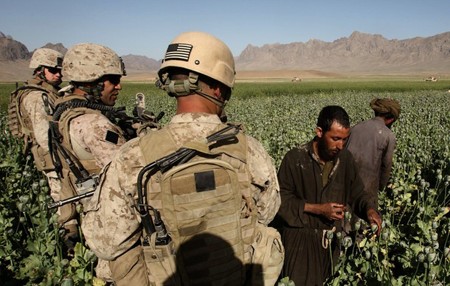
For many Westerners the war has lost its newness 'oh yeah, that's still going on, isn't it?' is not an uncommon reaction. Yet with more troops pouring into the country than ever before, there is no end in sight. As Afghanistan heads into elections – in a desperate pretense of normality – 4,000 US marines arrived in Afghanistan's troublesome Helmand province a few days ago. This is the biggest offensive since the war began. Surely there are now enough marines on the ground to completely flood Helmand's poppy fields and kill two birds with one stone: chase the Taliban out of the area and end opium production. Regime change and crop change in one fell swoop.
Guns and money should do it.
Guns will drive out the bad guys.
Money will pay for the roads that will allow consumer crops to be taken to market before they rot, pay the blood bondage that keeps many farmers tied to opium barons and pay cash incentives for the switch from the very profitable poppy to something far less profitable albeit more benign.
Guns will persuade the undecided. And the drug barons. Maybe.
Then when Afghanistan goes back to being a country, ideas of social responsibility, legality, social and agricultural development can be debated.
Trying to discuss those now, while the war is raging seems like a cruel joke. Pretending normality is simply lurking, pretending the war has not obliterated everything that used to be Afghanistan, for better or for worse.
Everything apart from the Taliban, that is.
Marines are now combing villages in areas that were until recently held by insurgents. The latest offensive is reputed to have met with little resistance. But that is not because the insurgents gave up. It is because the insurgents slipped away. Again. And the 'boundaries' moved. Again. And the Taliban retreated across the border to Pakistan, again, because Pakistan failed to up numbers and simply deployed the existing, insufficient garrisons. Again.
Same old then?
Well not exactly. There is some variation. NATO has put more emphasis on protecting the locals rather than killing the bad guys on this occasion. If it works, they'll stick with this model. Keeping them alive, you see, is the first step to convincing them we mean well. Next step – which is what the marines are working on now – is to persuade them we really are there to stay, the Taliban are not coming back and it is safe to vote in the upcoming presidential elections. Only problem? It's been five years that the Americans have been fighting the Taliban and, although still 'there' in large geographical terms, US forces have not always managed to successfully hold onto territory. What is now the domain of the marines tomorrow could be back in the hands of the Taliban. So although the marines are promising secure civic participation now, will they still be around tomorrow? Or will the Taliban be back, killing everyone who voted in the election against their explicit warning?
Do that and I'll kill you, say the Taliban wielding their guns. That's pretty persuasive. The Marines' job is to say 'don't mind them, we'll keep you safe'. But how convincing is that?
Captain Bill Pelletier stressed that there had been no civilian casualties or damage to property, no artillery, aerial bombings or other indirect fire in a long time. Read: things are improving. But is this progress enough for the Afghans to believe the Taliban are not coming back? After 5 years of inconclusive confrontations, what would it take for people to believe? And why would people risk their lives to vote in an election that means nothing, as what passes for their country now is a set of half-baked structures propped up by the US? Why risk your life to be a citizen of a war when the very war isn't even yours?
'Afghanistan' is not a country. It is a bloody conflict, a losing battle, shorthand for all the questions US decision makers forgot to ask before engaging.
'On s'engage, puis on voit' didn't work for Napoleon and it didn't work for Bush. So it makes sense if the Afghans themselves are reluctant to put their lives in the hands of US marines who, as an army should, can always resort to a tactical retreat if the Taliban return and things get ugly. This is a war, after all.
Only for some it's also home. Ravaged, unsafe but still home. Tactical retreat is not an option.
The US may be realising this. They have shifted their strategy, confirms military strategist Anthony Cordesman. They now seek to hold onto territory and build lasting security. Right. And what was the strategy before? Lose territory and wreak havoc?
Naturally that's not what Cordesman means. US forces have proved time and again that they can win battles. They have also proved (time and again) that they cannot hold territory or win over and keep the loyalty of the population. They need to provide security, create economic opportunity, minimize Taliban influence and battle the fear of what the Taliban will do to 'collaborators' were they to come back in order to start 'holding on' to what their guns can win them. Then and only then will 'reconstruction' make sense.
This is not rocket science.
We know this. We've known it for five years. We've been talking about it for five years. They have been talking about it for five years. So they have either been lying about their intention to really do it all this time or we need to face the simple fact that they just can't do it. Maybe it just can't be done. Not this way. Not by these people. Not right now.
Michael Clarke, director of the Royal United Services Institute, begs to differ. 'This is a very specific example of fighting for democracy' he told the Guardian. Really?
Whose democracy? Your democracy ain't there and Afghanistan doesn't have a democracy. And that's not the way to get one either. Democracy requires stable institutions and basic freedoms, it can therefore not exist in wartime. It also necessitates grass roots participation and public engagement so it cannot be offered as a gift by an external party. Especially if said external party is wearing camouflage gear.
We occupy land so people can register for the election in August, say the marines. We protect the civilians, even if it means avoiding confrontation with the Taliban.
In other words we fight the war by not fighting the battles. And we play at citizenship, when the country is dormant.
Don't get me wrong. I'd love for the war to stop right now. For all wars to stop right now for good. But what I love and what I know are at odds on this one and what I know is this: you fight a war to win it. Day to day political activity is subjected to martial law and normal liberties are suspended. When you had those to start off with. If you never had them, introducing them during wartime is not stupid. It is hypocritical, a simple case of being seen to be doing something while everything is failing.
Obama has rightly noted that the military solution alone in Afghanistan is doomed to failure. But what he meant was that the military cannot solve the underlying problems the country had before and as a result of the war. He did not mean a non-military solution will solve the problem that is the war. What he didn't say is that the implication of this is that infrastructure development and social healing cannot take place in war time and cannot be carried out by soldiers. Particularly not foreign soldiers.
And herein lies yet another challenge: alongside the 4,000 marines hitting the ground last week there were only 500 Afghan soldiers – a token force if there ever was one. In this war, the Afghans are on the other side or simply on the sidelines, giving the question 'whose war is this' immense poignancy. And while we are focusing on Helmand, the war is raging in the entire country.
'Afghanistan' is still going on. Five years on.
What are the Americans after, what are they fighting for? Does anyone remember any more? The administration has changed, times have changed and what they set out to fight against, fight for has also changed. Yet the war continues and there's no changing the fact that this is the Americans' war. They need to figure out what it is they are fighting for if they are ever going to end it, let alone win it. Democracy and freedom are not theirs to give and they are not why they are there in the first place. Lofty ideals keep troop morale high but values and bayonets don't mix well together.
Afghanistan is a war and it's the Americans war. They should figure it out. They should end it. Then they should leave.
When the soldiers leave, when peace returns, when democracy and liberty become possible even if they remain elusive; when Afghanistan belongs to the Afghans, then it has a chance of being a country again.
Till then, Afghanistan is no country, it is a war and any talk of reconstruction, democratisation and institution-building is simply trying to mask the fact that the war is still going on and it is going rather badly. For all involved.
Thursday, 23 April 2009
Remind me again – who did you say are the good guys?

Ah the Cold War. We knew who the villains were, we slept soundly in the knowledge we were with the good guys and James Bond movies had blissfully uncomplicated plotlines. Ok so that last bit hasn’t changed. But everything else has.
Now did I actually sleep soundly thanks to the Cold War?
No, not really.
I personally lived in constant fear of nuclear annihilation and could not possibly figure out why that terror of a man, Reagan, was supposed to be the good guy ahead of cuddly, smiley Gorbachev. But I was barely 10 when perestroika started so I am obviously nothing to go by here.
Still the fact remains: those who thought they knew where they stood with the cold war can say that no more. Sure, the Arabs are today’s bad guys. And they fit into the civilisational ‘us vs them’ battle over liberty and ‘our way of life’ (as well as banal questions of military supremacy and global power).
But not all Arabs are bad, now are they? Some are friends. But how do you tell them apart? And then, of course, those who are foe are not alone, are they? So many other bad guys to keep an eye on. Plus, this new generation of bad guy is very mobile. You don’t know where to point your missiles any more.
Add to that the fact that there are all sorts of allies we don’t really like all that much and you have a right headache in your struggle to safeguard freedom and the way of life we were talking about.
Take China for instance. Now that’s a good subject for someone interested in freedom, fairness, justice and democracy. A trading partner, of course. So we try not to bug them too much. Although, if truth be told, we are not too fond of them. Or their human rights record. Or their tendency to execute people en masse (and then sell their bodies to the West to be used in art exhibitions of dubious taste. Yes, yes it’s the Bodies exhibition I am talking about and, yes, I am squeamish). And now China has created an ever more degrading, even less controlled and monitored and even more outrageous way of killing off its own people: the mobile execution vehicle, the death-mobile, a van that can come to you and administer lethal injection in your own location. Trivialising life and death and laughing in the face of UN representatives speaking of China’s ‘improving human rights record’.
But stop press for a moment.
Have you thought that China’s record may well be improving, not out of any concerted effort to democratise, liberalise or play nice but simply because everybody else’s record is deteriorating at the speed of light?
I’m sure you all read the articles earlier this week – the CIA waterboarded two suspects 266 times during interrogations. Now 9/11 plotter Khalid Sheikh Mohammed and alleged terror commander Abu Zubaydah are bad guys. But that used to mean that they were prone to do things we wouldn’t do, us being the good guys. Thieves are bad because stealing is wrong, murderers are bad because life is sacred, rapists are evil because violation and violence is a sin, a crime and an abomination. So we are the good guys, not because we are victims of badness but because we wouldn’t do what bad guys do. Right?
Then explain torture to me, will you?
And before you tell me that Obama – blessed be his name – has banned waterboarding, let me tell you that it was happening till 2 months ago and, as Obama has not instructed a wide-spread inquest and purging of the CIA, waterboarding will stop but torture won’t.
Because 266 instances of waterboarding on 2 people says one thing and one thing alone: it happened a lot. And that, in turn, tells us an awful lot of things about how the CIA go about interrogating bad guys. And none of those things are good.
Now if you are of the ‘an eye for an eye’ school, you obviously disagree with me. Especially as we have now seen memos outlining how medical experts prevented waterboarding from causing severe mental or physical harm to the subject. So it’s not even an eye for an eye as we keep them alive.
Is that the measure of our humanity, then? Ensuring the pain doesn’t kill the suspect?
When did ‘who we are’ stop mattering?
Because who you are is measured half against what you do with you life and half against what you refuse to do. So, no, torture is not ok. Even if you have the worst of villains sitting across the interrogation table from you. And it’s not ok for three reasons:
1. What if you are wrong? What if hours, days, years from now you find that the guy who looked so evidently guilty on paper actually wasn’t? What if?
2. Revenge is not what our legal system is based on. Revenge is a bad motive and a bad reason for action. Revenge leads to the dark side.
3. If who you are entails a capacity and drive for violence, inflicting fear and pain on a defenceless – however horrible – human being, then you too my friend are one of the bad guys. Not as bad, perhaps, but bad all the same.
And making waterboarding illegal far from solves the problem
Because, don’t tell me that, when not using waterboarding, the CIA just had stern chats with their charges? And don’t tell me that, since Obama is not prosecuting any officials (not those who devised the policies, not those who carried out the interrogations, not those who failed to stop them) there will be a real change in how the supposed good guys interrogate the suspected bad guys?
And before you tell me that all’s fair in love and war, tell me how turning into what you are fighting against helps protect what you are fighting for?
Some fear that taking techniques off the table will make the enemies even more daring. More daring than what? What’s more daring than a suicide bomber?
And while experts debate whether torture ‘works’, whether accurate confessions are exacted through the medium of pain and the associated panic simulated drowning would cause, I maintain that this is not the point.
As a citizen, as a person, as an one-time ‘expert’ I refuse the ulta-right dismissal of the anti-torture argument as naïve and stand by my original proposition: humanity and morality cannot be fully separated. If you stand against the bad guys, don’t be a bad guy. If, in fighting a war, you compromise what you are striving to protect, you are your own worse enemy. And if you are fighting for freedom and democracy, well, then you can’t agree with Obama’s decision not to prosecute.
The point is that good is as good does. And no matter what desperate times call for, whatever popular wisdom absolutions you can think up, the fact remains: good guys should act like good guys, all the time, under any circumstances.
Even when doing so is difficult.
Particularly when doing so is difficult.
Labels:
Good guys,
Human rights,
Obama,
torture,
USA,
waterboarding
Tuesday, 17 March 2009
A lesson in losing perspective: Muntadhar al-Zaidi
Remember Muntadhar al-Zaidi?
We all cheered him when he threw a shoe at Bush in December last year. Some of us even thought ‘oh man, I wish I had done that’. We cheered him and we forgot about him. And when he was sentenced to three years in prison a few days ago, for attempting to assault a foreign leader, nobody really noticed.
Zaidi, a journalist, pleaded ‘not guilty’ to charges of assault, considering his act a reaction to the violence he and his people had suffered in the hands of the American invader. But as it often happens with these things, if you have an army, your trespasses are discussed in round tables, if you protest on your own, you soon find that most of what you can think of doing breaks the law. So Bush is sitting at home and Zaidi is going to jail.
Now, I'm not saying that chucking shoes at people you dislike is an acceptable form of political disagreement. I am saying that, in the context of Iraq, war changes the normal rules of the game.
Of course there is a debate to be had here about the limits of lawful protests and the boundaries of legitimate expressions of disagreement. But this debate cannot be had in war-torn Iraq, not yet. Not while the US occupation forces are still on the ground. Not while democracy and civil society are still just words in textbooks.
But rather than admitting that the debate regarding acceptable limits to freedom of expression cannot be had in the context of a war and what Zaidi did cannot be judged as if it were done in peace time, the court ploughed on ahead regardless.
Surely, when shoot-outs on the streets are a daily occurrence, the boundaries of what constitutes ‘violent behaviour’ ought to be slightly adjusted to fit reality?
But even if context is not taken into account, a three-year jail sentence is radically out of proportion with the nature of the crime, if flinging a shoe can be described as a crime at all, raising important questions about the sobriety, independence and reliability of Iraqi courts.
It is telling that Zaidi’s lawyers failed to convince the court to reduce the charge of attempted assault to insult. The courts were evidently making a point, still the tragic irony of the terminology is way too poignant: In the context of an on-going war, you would expect people to know the difference between a flying loafer and mortar. But everyone is in a flap over insulting the Americans and moderation has gone out the window. Premier Nuri Al-Maliki described the throwing of the shoe as a ‘barbaric act’ in December, earning himself universal scorn for having no sense of perspective. Obviously the sentencing has done his reputation as an American mouthpiece no favours.
The Journalistic Freedoms Observatory is shocked and dismayed at the harshness of the decision. Public opinion in Iraq, however, remains divided, some believing that a foreign guest should not be insulted under any circumstances and a journalist should be able to keep a cooler head. Others of course have hailed Zaidi as a hero.
The court had a chance to diffuse this situation without taking sides, but the harshness of the sentence imposed shows they have no such intention.
The anti-American Shiite factions have already accused the pro-US factions of leaning too heavily on the judges while the response form Maliki’s party was the incredibly callous: “If this case was politicized, the punishment would have been harsher.”
And the Americans?
Desperate to leave Iraq, they have stopped caring about their legacy.
This was a unique opportunity to lead, to inspire, to show what democracy, free speech and toleration look like in practice.
Maybe they did lean on the judiciary to get retribution of sorts – and if that happened it shows a complete lack of vision, humanity and imagination.
But maybe they didn’t lean on the judiciary at all. They left the Iraqi judges to fret over expunging the insult and placating the Americans on their own and, in doing so, they missed a momentous opportunity to lead, teach and inspire.
So Zaidi is going to prison for throwing a shoe at Bush.
Bush goes home to tend to his presidential library after carpet-bombing Zaidi's country.
And ‘democracy-building’ in Iraq has gone from being an empty shell to a hollow promise, not even symbolically upheld by those who made it.
So when we start wondering when America went beyond caring about democratisation in Iraq, remember Muntadhar al-Zaidi.
Wednesday, 11 March 2009
Broken Record Day: Afghanistan
If I’m going to say the same thing over and over again anyway, I might as well pretend it’s all part of the plan.
So I hereby create the institution of the ‘Broken Record Day’ during which I am allowed to repeat myself and go on and on about the things that really bug me.
That sorted, I might as well inform you that today is a broken record day and my subject is Afghanistan. Then again, when the subject is Afghanistan, every day is a broken record day.
Things are not going well in Afghanistan.
Things have not gone well in Afghanistan since the beginning of the operation.
Of course, there have been good days and bad days.
But on an average day it is evident that US and coalition forces are approaching this all wrong: from rotating troops out of the country pretty much the minute they are beginning to understand what’s happening on the ground; to falling prey to cheap emotional tricks like trying to befriend the local children and being drawn into ambushes; to getting caught up in regional and tribal disputes they do not understand and cannot resolve - but can exacerbate. And exacerbate them they do.
No-one is saying it’s easy.
The US troops are battling on many fronts: fighting the insurrection; trying to help Afghanistan build new institutions, structures and a new political culture; undermining these institutions, structures and culture via their very presence; fighting the drug cartels; trying to discourage poppy cultivation and encourage alternative crop cultivation whilst simultaneously trying to build the roads via which the alternative crops will be taken to market without rotting while the farmers are negotiating treacherous terrain; grappling with the centuries’ old system of feudal debt and bondage that would keep farmers bound to poppy cultivation even if viable alternatives did exist; watching their reconstruction work being undermined by their counter-insurgency fighting and their counter-insurgency fighting hampered by their reconstruction work.
It’s not easy.
But it was never going to be easy.
And now accusations are being made that US forces are failing to share counter-insurgency intelligence with their international military allies.
A report prepared by RAND and leaked to Wikileaks suggests that efforts in Afghanistan are hampered by the twin evils of US commanders being overwhelmed by information on hundreds of contradictory databases and the same commanders not comparing notes and/or sharing this information with their counterparts within the coalition.
Meanwhile much of this closely guarded intelligence is coming from local contacts that get tipped for every tip they offer, thus providing unreliable and often erroneous information that the US army then spends time and money to code, analyse, counter-reference and guard. From their own allies, among others.
The report describes a force drowning. In information. In confusion. In despair.
Having gone in without a plan.
Realising slowly that the military commanders do not understand Afghanistan with its tribal politics, deep-rooted religious entanglement and drug-fuelled economy based on debt bondage and serfdom.
And now, not seeing a way out that wouldn’t push the country over the brink into complete civil war and political disintegration, the force is drowning.
Things are not good for the US troops.
But they still need to send reports home. And ‘we are in this way over our heads’ is not a good report. Besides, you can only say it so many times.
So, it seems, the US forces have devised complex economic, military and political ‘progress indicators’ the relevance of which is shaky but the purpose clear: they allow for reports to be sent back home, for activity to be measured, for an illusion of progress to be maintained.
All the while, according to the same report, coalition forces at Camp Holland near Tarin Kowt in southern Afghanistan maintain 13 different intelligence sections as nobody is talking to anyone else.
If nothing else, the coalition is leading by example: a true inspiration for the fragmented, tribal and bitterly divided Afghan society.
Broken record day.
You cannot provide a solution to a problem you do not understand.
You cannot navigate an unknown land without a map or compass.
Good intentions and a cheery disposition suffice only if your name is Polyanna.
‘On s’engage et puis on voit’ didn’t work out all that well for Napoleon.
Why Bush thought it would work out for him beats me.
And yes, I know: ‘No plan survives contact with the enemy’.
I know.
But if you start out without a plan, without even knowing what you are setting out to achieve, in general terms, it’s you that may not survive contact with the enemy. Especially if your enemy knows what he’s fighting for, and you don’t.
Monday, 9 March 2009
When looking ahead is hard, look back and look busy
For 5 points, political science:
What is the function of the US Congress?
If you answered ‘legislation’ you get 5 points. But if you answered ‘to serve as the forum in which political vendettas and ideological politics are all played out’ you also get 5 points. Because debate within Congress is partly about making laws and partly about making a point. And I can’t help thinking that the latest push towards passing a resolution that describes the Ottoman massacres of the Armenians on the run-up to and during the First World War as ‘genocide’ is little more than that. I am just not sure what the point is.
Despite placating the Armenian lobby.
Despite giving the beleaguered Armenian nation a belated moral victory.
Despite looking back and nodding wisely.
Despite all this, I fear that this gesture is just that – a gesture – a symbolic pat on the head and not the start of a global preventative initiative.
Almost a century has gone by since the Armenian massacres the proposed Congress resolution is dealing with occurred. And although the memory of the pain and the horror remains, none of the political players do.
At the time, Armenia was not yet a state.
The state that perpetrated the crimes (the Ottoman Empire) no longer exists.
The state that replaced it (Turkey) came into being partly by rebelling against and rejecting the Ottoman Empire. It has a new polity, new legal system, new language and script, new capital and no state religion. It is in all ways different to the Ottoman Empire, difference compounded by rejection when the nationalists rebelled against the Ottomans. This is not our crime, say the Turks. And nobody is actually accusing the Republic of a crime that was perpetrated before it existed. But the ‘Armenian question’ makes Turks feel put on the spot, accused, provoked to respond. And respond they do. Most vociferously. And then of course the world thinks ‘the lady doth protest too much’. And Turkey is looked at suspiciously. And the cycle continues.
So if the resolution passes, it will be castigating a country that no longer exists. It will be offending a country that is only linked to the horrors perpetrated by history and association but not institutional continuity and ‘national’ collective responsibility. And it will be giving the Armenians a nod. Nothing more. The resolution is offering no reparations, no redress and no promise that we have learnt from this particular horror, as a species. All that is offered is a piece of paper saying that the horrors endured by the Armenians a century ago were comparable to the horrors endured by the Jews during World War II.
Because that’s what the term ‘genocide’ boils down to.
Of course, it has been used since and for other cases but when Raphael Lemkin first wrote of genocide in 1944 he only had one thing in mind: to build legislation that would punish the perpetrators and avoid a repetition of the horrors of the Holocaust.
It didn’t work.
Genocide predated its name and outlived Lemkin.
But what we have had since Lemkin is a body of international law and the right language to understand, isolate, describe and – on few occasions – punish the crime that is genocide.
But this being a body of law, it all gets technical, as one of the criteria for proving a massacre constitutes genocide is that specific intent needs to be proved. The letter of the law requires a paper trail or suchlike proving that the killings are part of a sustained policy to annihilate an ethnic group as such, people being killed because they belong to that ethnic group.
Rwanda – with the extensive incendiary media coverage exhorting members of one group to kill members of another, qualifies.
The Armenian case is more complicated.
The Armenian massacres occurred before the information age. There were no media campaigns. The dissolution of the Ottoman state means that even if paper trails existed then, they no longer do. And chances are they never did as high levels of illiteracy meant that orders had to be given orally in the most part.
It was a different time. The definition does not apply. Still, the deaths occurred and the legal assessment makes them no more and no less real.
The resolution may ignore all this and call it a genocide regardless.
And yet this will offer little comfort to Armenians – only the bittersweet aftertaste of a minor and long overdue moral victory. If giving a title to suffering can be counted as a victory. Meanwhile the Turks will feel slighted and wronged. A minor diplomatic episode might ensue. But they too will get over it.
And then what?
Then we all go back home.
And if new atrocities occur, we make sure we wait a good hundred years before assessing exactly what is going on, why it is happening and just how horrible it is.
Of course time gives us perspective.
Time also ensures we don’t have to get our hands dirty in the messy business of saving lives and preventing slaughter before it becomes genocide.
Time allows for taxonomy.
Time is the enemy of survival.
I do not object to the sentiment behind this resolution.
I also appreciate the technical debate around this. I am quite fond of taxonomy. I like legal definitions and pedantic arguments.
But the US Congress is not a historical society.
For Congress this is not about a moral choice. This is a choice between looking back, looking busy or looking straight ahead.
The victim often has no choice but to look back.
The law-maker always has a choice.
Call me pedantic, but given the choice, I’d rather law-makers opted for looking ahead rather than looking back and looking busy.
Because that’s as bad as looking the other way as things actually occur.
Wednesday, 4 February 2009
Obama’s first stumble or my chance to say ‘I told you so’
Did I or did I not say that those cheering for Obama will be the first to criticise his inability to magically fix the world and ensure we all live happily ever after, like in the fairy tales, with royalty in our beds and white stallions in our stables?
I said it, of course I did. I told you so and I was right. And much as I love being right (and saying ‘I told you so’) this one is annoying me.
And it’s annoying me because Obama screwed up as much as because people somehow expect Washington and the entire political establishment to be new, fresh and clean ‘now that Obama is around’.
So today we wake up to banner-sized headlines – ‘Obama admits: I screwed up’. Why? Well, because he said it, obviously.
And why did he say it? Because being able to hold his hand up and say ‘mea culpa’ is part of the persona he’s projecting, part of the reason we liked him in the first place.
But did he screw up? Yes, of course he did. And I’ve got news: he will again. And again. And again. Because he’s human, because politics is a dirty game, because Washington is a tricky bio-system with its own rules of engagement. And because (oh blessed subjectivity) some of us will forever disagree with what he chooses to do.
But back to today. The man promised to clean up politics in Washington. That is a hard promise to keep for anyone without the magic wand I’ve been going on about. So what does his promise entail?
Effort. Relentless effort.
And?
Well, he’s already not trying hard enough.
Tom Daschle, a former Democratic leader in the Senate and Obama mentor, had to withdraw as cabinet nominee because he had not paid his taxes.
I know places where no-one would blink at this, but America is not one of them and that is as it should be.
Obviously, this is embarrassing. Particularly because this is the third Obama appointee with tax problems. And that’s not counting one confirmation that went through despite the tax problems… One person is an accident. Four is a trend.
But does this trend say more about Obama’s insincerity or the pool of people he can pick from?
I’m not suggesting all politicians and politicos are tax evaders. But I am saying that angels don’t do politics. They leave it to humans. And humans err. A lot.
But to make matters worse, tax is not the only problem with Daschle, who has been making his living since leaving the senate in 2004 through informal lobbying and advisory work. Doing, in other words, exactly the sort of thing that Obama castigates as damaging to the political process.
As I was saying, embarrassing.
But I would not say Obama is insincere – at least not yet.
I’d say the first reality check has hit him and when it did, to use his own words, he screwed up.
Obama campaigned on the loftiest messages, he promised big, as people do during campaigns. But he’s not campaigning any more and the collision with the real world was inevitable and, considering, quite mild.
Obama must realise the real work begins now and his message needs to be tailored not to what he’d like to do, but to what he can do.
A steep descent but a necessary one.
Meanwhile, the rest of us need to come to terms with the fact that he hasn’t got a magic wand, he can’t just do away with the bad stuff and he can’t operate in a vacuum – past policy and the Washington political nexus will constrain him every step of the way. That’s how it will be and don’t say I didn’t tell you so because I’ve been saying it since before his inauguration. You just haven’t been paying attention.
So he screwed up. Big time.
He screwed up by over-promising. And by trying to brush this one under the carpet (saying that tax lapses are mistakes that should not stand in the way of confirmation) before deciding to come up and say I screwed up and let's move on. And by picking the wrong people to work with. Assuming that the right people exist in the first place.
No matter what he does, Obama will be better than Bush. But the gulf between ‘better than bad’ and ‘miraculous’ is huge and don’t tell me I didn’t tell you so.
Some of the questions facing Obama now have no good answers. Only different degrees of bad.
Some of the decisions he will make in the future, will be driven by political expediency and not lofty ideals.
Because he’s a new guy in the same old world with all the baggage of the other guy still on his back. And because angels don’t do politics, they leave that to humans.
And humans err. As Obama did and as Obama will.
And when he does, don’t say I didn’t tell you so.
Thursday, 29 January 2009
Liberalism 101
A woman in the US of A is running the risk of having her children taken away by social services because they have Nazi-inspired names including ‘Adolf Hitler’ and ‘Aryan Nation’. That’s a middle name. In case you were wondering.
Cruel? Absolutely.
Distasteful? Totally.
Worthy of social services intervention? I’d say no.
Of course there may be more to this than the parents’ poor taste and horrendous political affiliations. Although so far there doesn’t seem to be. And if those children were taken away because their mum has Nazi sympathies, then we have a problem. Because freedom is not faring well, when it only applies to those who agree with us.
Of course the concern is valid – in a liberal democracy, can you allow the expression of views the logical conclusion of which would be the dissolution of the very foundation of the freedoms you so cherish? I’d love to say no. But if you silence those who would silence you, you are no better than they are.
Still, it’s a tough call to make.
But choice is what freedom is about. The choices you are allowed to make because you are free. And the choices you must make in order to be free.
And obviously none of this is simple. And it all got a whole-lot more complicated post 9/11 when we were told we could either be safe or free. Freedoms, we were told, had to be curtailed for our own good. More surveillance, longer periods of detention for those arrested on suspicion of threatening our lives or way of life, new legislation, more monitoring. Freedom of expression is now a heavily qualified proposition. In the name of security: our safety and the protection of our way of life.
And many of us accepted limits to freedom in the name of security – because what good is freedom to a dead guy?
Even though our freedoms were secured by many who died demanding or defending them.
Even though security and freedom do not have to be mutually exclusive, unless we make them so.
Even though our way of life was meant to be all about freedom in the first place.
Wasn’t the right to have unpopular opinions part of what we used to stand for? Part of what we used to fight for?
Freedom was never meant to come in one size, one shape and one flavour.
Freedom was never meant to make life easier. It was meant to make life better.
Freedom was never meant to be restricted to those we like. That was the whole point: freedom was meant to make us bigger than the bad guys.
As I was saying, liberalism for beginners. But maybe it’s time we went back to basics.
Cruel? Absolutely.
Distasteful? Totally.
Worthy of social services intervention? I’d say no.
Of course there may be more to this than the parents’ poor taste and horrendous political affiliations. Although so far there doesn’t seem to be. And if those children were taken away because their mum has Nazi sympathies, then we have a problem. Because freedom is not faring well, when it only applies to those who agree with us.
Of course the concern is valid – in a liberal democracy, can you allow the expression of views the logical conclusion of which would be the dissolution of the very foundation of the freedoms you so cherish? I’d love to say no. But if you silence those who would silence you, you are no better than they are.
Still, it’s a tough call to make.
But choice is what freedom is about. The choices you are allowed to make because you are free. And the choices you must make in order to be free.
And obviously none of this is simple. And it all got a whole-lot more complicated post 9/11 when we were told we could either be safe or free. Freedoms, we were told, had to be curtailed for our own good. More surveillance, longer periods of detention for those arrested on suspicion of threatening our lives or way of life, new legislation, more monitoring. Freedom of expression is now a heavily qualified proposition. In the name of security: our safety and the protection of our way of life.
And many of us accepted limits to freedom in the name of security – because what good is freedom to a dead guy?
Even though our freedoms were secured by many who died demanding or defending them.
Even though security and freedom do not have to be mutually exclusive, unless we make them so.
Even though our way of life was meant to be all about freedom in the first place.
Wasn’t the right to have unpopular opinions part of what we used to stand for? Part of what we used to fight for?
Freedom was never meant to come in one size, one shape and one flavour.
Freedom was never meant to make life easier. It was meant to make life better.
Freedom was never meant to be restricted to those we like. That was the whole point: freedom was meant to make us bigger than the bad guys.
As I was saying, liberalism for beginners. But maybe it’s time we went back to basics.
Subscribe to:
Posts (Atom)