Showing posts with label Afghanistan. Show all posts

Thursday, 12 November 2009

Afghanistan: does defeat go away if you refuse to accept it?


'The key is knowing when to call it a day' said my great uncle.
Although he was talking about drinking and not troop deployment to treacherous war zones, the rule applies. And the rule is this: if you set out to achieve something within a given time frame, and the time frame has elapsed many times over, and what you set out to achieve still eludes you then you have failed and the one thing that is guaranteed to not make the situation any better is a determination to carry on doing what you have been doing because, well, that's the bit that failed.

Modern warfare is nothing like old school sieges. Battering the wall until it cracks worked against medieval citadels but doesn't take you very far as a parable for modern war tactics.

What am I talking about?
I am talking about the front page of yesterday's Times.
I quote: 'President Obama is to ask members of NATO to provide up to 4,000 more troops to help break the deadlock in Afghanistan'. And a good morning to you too.

Although Obama's appeal is expected to go largely unheeded, 35,000 additional US troops are expected to hit Afghanistan before long with supplementary units from Britain and Turkey possibly joining them before long. Possibly.

Talk, of course, is around credibility: the credibility of the alliance if no troops are forthcoming... the credibility of President Obama himself, if his request is ignored... the credibility of the AK party government in Turkey if they send a few hundred more troops... and of course the credibility of our own superhero, Gordon Brown, whose willingness to send more troops is going down with the voters like a proverbial lead balloon. As is his explanation, that he's staying in this war to keep Britain safe.

The war rhetoric has no mileage in it any more.
Democracy for the Afghans peace for the world. Nice idea. Pity about the outcome.

Democratisation sounds good. But after last month's election debacle, I am surprised world leaders still mention democracy and Afghanistan in the same sentence without dying of shame.
'Indelible ink that washed off, voters walking home with whole ballot boxes, election monitors who didn't dare leave their NATO base'. You don't believe me, fish out your back copy of the Guardian (20.10.09) and see for yourself.

Is this our fault? I hear you ask. Hell yes. Have you forgotten the rhetoric? The promises? The democracy banners we waved the world over to justify the invasion and continued presence of allied troops in Afghan provinces up and down the country? Democracy is what we were there to give. Allegedly. Elections were the West's idea and were supposed to take place under our tutelage and protection. Go us. And by this time round the Afghans were supposed to have picked up a few tricks, willing and able disciples of worthy tutors.

As it turned out, the election was not exactly a showcase of democracy in action.

I am not suggesting the allied troops had anything to do with rigging the election. Karzai and his cronies did that all on their own – although their ineptitude even at that suggests they could have used some help, with hindsight. But then again, Karzai could not have had any more help, realistically: from being hand-picked and propped up every step of the way, to being given trust he had not earned as he repeatedly refused there was a fraud problem of any real magnitude on American TV. Not to mention the international community simply not intervening at any point during proceedings, trusting, cowering. Stalling. Failing to pre-empt, failing to prevent, failing to end the abuses.
Failing.
Failing at delivering democracy to the Afghans and peace to the world.

And while the democratisation experiment is clearly not working (yet), more troops are needed in the name of peace, we are told.
Only UK voters are not buying any of this any more.
According to a poll published in yesterday's Independent '4 out of 5 of those questioned do not believe that British involvement in the conflict... is keeping the streets of Britain safe from terrorist attacks'.

So. If by being in Afghanistan we are not helping them and we are not helping ourselves, why exactly are we there still and how will 35,000 additional US soldiers and another 4,000 allied troops help achieve what we are failing at?

Put it this way: How will more troops prevent future killings from corrupt Afghan police officers? I'll tell you how. By taking patrolling away from them and putting it back in the hands of allied troops. By entrenching their presence even further.

But what else can you do? When you have failed but cannot stop doing the same thing... partly because you have no other ideas and partly because you have unleashed forces you cannot control and have managed to leave yourself no way out. What else can you do? Because when you went in, it did not occur to you that an exit strategy may be needed. Because it never occurred to the leadership that it may just be essential to call it a day at some point.

More troops then.
Because we have worked our way clean out of options. More troops.
Because we have ran out of ideas and need to be seen to be doing something.
More troops.
Even though that does not change the fact that refusing to admit defeat doesn't mean you are winning.

Monday, 13 July 2009

Afghanistan is a war, not a country


Afghanistan is a forgotten country.
We all know where it is but most of us forget what it is. To most people, Afghanistan is a war. A policy point. A problem.
US democratisation initiatives try to remind us that Afghanistan used to be a country, that there is future after the war. The problem is, whatever the future holds post-war, Afghanistan has been at war for so long that there is little left that could be called a country and what is still there, is at war.

Where does this story begin? With the Americans arriving five years ago? With the Taliban taking power? With the Soviets? When was Afghanistan not at war? When was it last just a country? And how does this story end?

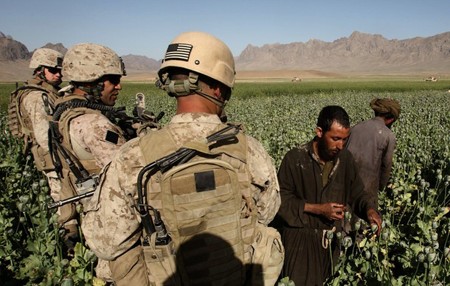
For many Westerners the war has lost its newness 'oh yeah, that's still going on, isn't it?' is not an uncommon reaction. Yet with more troops pouring into the country than ever before, there is no end in sight. As Afghanistan heads into elections – in a desperate pretense of normality – 4,000 US marines arrived in Afghanistan's troublesome Helmand province a few days ago. This is the biggest offensive since the war began. Surely there are now enough marines on the ground to completely flood Helmand's poppy fields and kill two birds with one stone: chase the Taliban out of the area and end opium production. Regime change and crop change in one fell swoop.

Guns and money should do it.
Guns will drive out the bad guys.
Money will pay for the roads that will allow consumer crops to be taken to market before they rot, pay the blood bondage that keeps many farmers tied to opium barons and pay cash incentives for the switch from the very profitable poppy to something far less profitable albeit more benign.
Guns will persuade the undecided. And the drug barons. Maybe.
Then when Afghanistan goes back to being a country, ideas of social responsibility, legality, social and agricultural development can be debated.
Trying to discuss those now, while the war is raging seems like a cruel joke. Pretending normality is simply lurking, pretending the war has not obliterated everything that used to be Afghanistan, for better or for worse.

Everything apart from the Taliban, that is.

Marines are now combing villages in areas that were until recently held by insurgents. The latest offensive is reputed to have met with little resistance. But that is not because the insurgents gave up. It is because the insurgents slipped away. Again. And the 'boundaries' moved. Again. And the Taliban retreated across the border to Pakistan, again, because Pakistan failed to up numbers and simply deployed the existing, insufficient garrisons. Again.

Same old then?
Well not exactly. There is some variation. NATO has put more emphasis on protecting the locals rather than killing the bad guys on this occasion. If it works, they'll stick with this model. Keeping them alive, you see, is the first step to convincing them we mean well. Next step – which is what the marines are working on now – is to persuade them we really are there to stay, the Taliban are not coming back and it is safe to vote in the upcoming presidential elections. Only problem? It's been five years that the Americans have been fighting the Taliban and, although still 'there' in large geographical terms, US forces have not always managed to successfully hold onto territory. What is now the domain of the marines tomorrow could be back in the hands of the Taliban. So although the marines are promising secure civic participation now, will they still be around tomorrow? Or will the Taliban be back, killing everyone who voted in the election against their explicit warning?
Do that and I'll kill you, say the Taliban wielding their guns. That's pretty persuasive. The Marines' job is to say 'don't mind them, we'll keep you safe'. But how convincing is that?

Captain Bill Pelletier stressed that there had been no civilian casualties or damage to property, no artillery, aerial bombings or other indirect fire in a long time. Read: things are improving. But is this progress enough for the Afghans to believe the Taliban are not coming back? After 5 years of inconclusive confrontations, what would it take for people to believe? And why would people risk their lives to vote in an election that means nothing, as what passes for their country now is a set of half-baked structures propped up by the US? Why risk your life to be a citizen of a war when the very war isn't even yours?

'Afghanistan' is not a country. It is a bloody conflict, a losing battle, shorthand for all the questions US decision makers forgot to ask before engaging.
'On s'engage, puis on voit' didn't work for Napoleon and it didn't work for Bush. So it makes sense if the Afghans themselves are reluctant to put their lives in the hands of US marines who, as an army should, can always resort to a tactical retreat if the Taliban return and things get ugly. This is a war, after all.
Only for some it's also home. Ravaged, unsafe but still home. Tactical retreat is not an option.

The US may be realising this. They have shifted their strategy, confirms military strategist Anthony Cordesman. They now seek to hold onto territory and build lasting security. Right. And what was the strategy before? Lose territory and wreak havoc?

Naturally that's not what Cordesman means. US forces have proved time and again that they can win battles. They have also proved (time and again) that they cannot hold territory or win over and keep the loyalty of the population. They need to provide security, create economic opportunity, minimize Taliban influence and battle the fear of what the Taliban will do to 'collaborators' were they to come back in order to start 'holding on' to what their guns can win them. Then and only then will 'reconstruction' make sense.

This is not rocket science.
We know this. We've known it for five years. We've been talking about it for five years. They have been talking about it for five years. So they have either been lying about their intention to really do it all this time or we need to face the simple fact that they just can't do it. Maybe it just can't be done. Not this way. Not by these people. Not right now.

Michael Clarke, director of the Royal United Services Institute, begs to differ. 'This is a very specific example of fighting for democracy' he told the Guardian. Really?
Whose democracy? Your democracy ain't there and Afghanistan doesn't have a democracy. And that's not the way to get one either. Democracy requires stable institutions and basic freedoms, it can therefore not exist in wartime. It also necessitates grass roots participation and public engagement so it cannot be offered as a gift by an external party. Especially if said external party is wearing camouflage gear.

We occupy land so people can register for the election in August, say the marines. We protect the civilians, even if it means avoiding confrontation with the Taliban.
In other words we fight the war by not fighting the battles. And we play at citizenship, when the country is dormant.

Don't get me wrong. I'd love for the war to stop right now. For all wars to stop right now for good. But what I love and what I know are at odds on this one and what I know is this: you fight a war to win it. Day to day political activity is subjected to martial law and normal liberties are suspended. When you had those to start off with. If you never had them, introducing them during wartime is not stupid. It is hypocritical, a simple case of being seen to be doing something while everything is failing.

Obama has rightly noted that the military solution alone in Afghanistan is doomed to failure. But what he meant was that the military cannot solve the underlying problems the country had before and as a result of the war. He did not mean a non-military solution will solve the problem that is the war. What he didn't say is that the implication of this is that infrastructure development and social healing cannot take place in war time and cannot be carried out by soldiers. Particularly not foreign soldiers.

And herein lies yet another challenge: alongside the 4,000 marines hitting the ground last week there were only 500 Afghan soldiers – a token force if there ever was one. In this war, the Afghans are on the other side or simply on the sidelines, giving the question 'whose war is this' immense poignancy. And while we are focusing on Helmand, the war is raging in the entire country.
'Afghanistan' is still going on. Five years on.

What are the Americans after, what are they fighting for? Does anyone remember any more? The administration has changed, times have changed and what they set out to fight against, fight for has also changed. Yet the war continues and there's no changing the fact that this is the Americans' war. They need to figure out what it is they are fighting for if they are ever going to end it, let alone win it. Democracy and freedom are not theirs to give and they are not why they are there in the first place. Lofty ideals keep troop morale high but values and bayonets don't mix well together.

Afghanistan is a war and it's the Americans war. They should figure it out. They should end it. Then they should leave.
When the soldiers leave, when peace returns, when democracy and liberty become possible even if they remain elusive; when Afghanistan belongs to the Afghans, then it has a chance of being a country again.
Till then, Afghanistan is no country, it is a war and any talk of reconstruction, democratisation and institution-building is simply trying to mask the fact that the war is still going on and it is going rather badly. For all involved.

Wednesday, 11 March 2009

Broken Record Day: Afghanistan


If I’m going to say the same thing over and over again anyway, I might as well pretend it’s all part of the plan.
So I hereby create the institution of the ‘Broken Record Day’ during which I am allowed to repeat myself and go on and on about the things that really bug me.
That sorted, I might as well inform you that today is a broken record day and my subject is Afghanistan. Then again, when the subject is Afghanistan, every day is a broken record day.

Things are not going well in Afghanistan.
Things have not gone well in Afghanistan since the beginning of the operation.
Of course, there have been good days and bad days.
But on an average day it is evident that US and coalition forces are approaching this all wrong: from rotating troops out of the country pretty much the minute they are beginning to understand what’s happening on the ground; to falling prey to cheap emotional tricks like trying to befriend the local children and being drawn into ambushes; to getting caught up in regional and tribal disputes they do not understand and cannot resolve - but can exacerbate. And exacerbate them they do.

No-one is saying it’s easy.
The US troops are battling on many fronts: fighting the insurrection; trying to help Afghanistan build new institutions, structures and a new political culture; undermining these institutions, structures and culture via their very presence; fighting the drug cartels; trying to discourage poppy cultivation and encourage alternative crop cultivation whilst simultaneously trying to build the roads via which the alternative crops will be taken to market without rotting while the farmers are negotiating treacherous terrain; grappling with the centuries’ old system of feudal debt and bondage that would keep farmers bound to poppy cultivation even if viable alternatives did exist; watching their reconstruction work being undermined by their counter-insurgency fighting and their counter-insurgency fighting hampered by their reconstruction work.

It’s not easy.
But it was never going to be easy.

And now accusations are being made that US forces are failing to share counter-insurgency intelligence with their international military allies.
A report prepared by RAND and leaked to Wikileaks suggests that efforts in Afghanistan are hampered by the twin evils of US commanders being overwhelmed by information on hundreds of contradictory databases and the same commanders not comparing notes and/or sharing this information with their counterparts within the coalition.
Meanwhile much of this closely guarded intelligence is coming from local contacts that get tipped for every tip they offer, thus providing unreliable and often erroneous information that the US army then spends time and money to code, analyse, counter-reference and guard. From their own allies, among others.

The report describes a force drowning. In information. In confusion. In despair.
Having gone in without a plan.
Realising slowly that the military commanders do not understand Afghanistan with its tribal politics, deep-rooted religious entanglement and drug-fuelled economy based on debt bondage and serfdom.
And now, not seeing a way out that wouldn’t push the country over the brink into complete civil war and political disintegration, the force is drowning.

Things are not good for the US troops.
But they still need to send reports home. And ‘we are in this way over our heads’ is not a good report. Besides, you can only say it so many times.
So, it seems, the US forces have devised complex economic, military and political ‘progress indicators’ the relevance of which is shaky but the purpose clear: they allow for reports to be sent back home, for activity to be measured, for an illusion of progress to be maintained.

All the while, according to the same report, coalition forces at Camp Holland near Tarin Kowt in southern Afghanistan maintain 13 different intelligence sections as nobody is talking to anyone else.
If nothing else, the coalition is leading by example: a true inspiration for the fragmented, tribal and bitterly divided Afghan society.

Broken record day.
You cannot provide a solution to a problem you do not understand.
You cannot navigate an unknown land without a map or compass.
Good intentions and a cheery disposition suffice only if your name is Polyanna.

‘On s’engage et puis on voit’ didn’t work out all that well for Napoleon.
Why Bush thought it would work out for him beats me.

And yes, I know: ‘No plan survives contact with the enemy’.
I know.
But if you start out without a plan, without even knowing what you are setting out to achieve, in general terms, it’s you that may not survive contact with the enemy. Especially if your enemy knows what he’s fighting for, and you don’t.

Friday, 16 January 2009

Afghanistan: time for a new plan

Here it goes again.
A few days before the inauguration and people are bemoaning well-known ills such as the utter failure of the Afghanistan reconstruction effort.
It is not news because it is not new.
Yet it will never stop being news because the whole endeavour has been such a monumental failure.
Plus we are all secretly hoping that what Bush broke, Obama will fix.
That magic wand again.

So we are back to talking about the privatisation of the war in Iraq and Afghanistan. Security companies, reconstruction agencies, catering outfits, engineering firms. They are all out there making a buck, doing good, messing up.
And journalists exclaim that ‘privatisation is benefiting the privateers’. Well done Sherlock.
And they also bemoan the fact that foreign aid funds don’t actually leave the US. Which they do. They just come back in, as most private businesses supporting the reconstruction effort are US-based. That bit, however, is not a mistake. It was always part of the plan. A plan we didn’t know about till it was too late to do something about. A plan we may not like. But a plan nonetheless.

And the thing about mistakes is that you can fix them or at least try. With plans, that’s trickier.
Because before the plan, comes the implementation, before that the groundwork, before that the decision-making. So someone, somewhere had what he thought was a good idea and set out putting it to practice.
Privatisation is an old idea and one that successive administrations thought good. It goes back to the Vietnam war. Clinton stepped it up. Bush went to town with it.
It was all part of the plan. A plan that we now see is not working.
But let’s go back to when the plan was hatched and what do we see?
Decades of groundwork and implementation. In other words, decades during which ‘other ways of doing things’ atrophied as they were not part of the plan.

So we need a new plan.
That’s not news either.
We need the decision-making – this bit Obama can do without a wand.
We need the groundwork and implementation. We need the result.
But all this takes time. Because first you need to reverse what is, to open up space for what could be. And while you are doing that, you need to find a way to carry on doing what you need to be doing. And if the old way is the only way, then you are stuck with the old plan for a while. Because the US won’t and shouldn’t stop reconstruction efforts.
So the money will carry on going to whomever has been leading the effort so far. USAID and commercial entities such as the Louis Berger group or private security companies such as DynCorp.

The truth is, much as we don’t like it, we can live with this a bit longer. As long as it’s part of a plan. A new plan that will eventually lead to a new way of doing things.
This is the time for decision-making.
And while the groundwork and implementation phases are unfolding, we will be patient. And we will await the result of the new plan.
Just as long as Obama doesn’t say ‘we are stuck with this for now, so we are stuck full stop’. As long as he says ‘we’re stuck now, but we have a plan’.
As long as he has a plan.